Karimen exam no 16
30:00
Question 1. When seeing the traffic sign shown in the figure, a driver is required to stop their vehicle completely, even if no vehicles or pedestrians are present on either side.

Question 2. At an intersection with the traffic signal shown in the figure, vehicles can freely choose to go straight, turn left, or turn right.

Question 3. In Japan, drivers must ensure that all passengers, including those in the rear seats, wear seatbelts during vehicle operation.
Question 4. A standard Japanese driver’s license allows the operation of both ordinary mopeds and small special vehicles.
Question 5. When turning right on a one-way street, a vehicle must first approach the right edge of the road and decelerate near the intersection’s center, adhering to any arrow markings (except at roundabouts).
Question 6. In Japan, it is illegal to operate a vehicle while holding and using a mobile phone for calls or texting.
Question 7. Japanese traffic law requires that children under 6 years old be secured in an approved child restraint system when riding in a vehicle.
Question 8. The default speed limit for passenger cars on Japanese expressways, unless otherwise indicated, is 100 km/h.
Question 9. If there is enough space on the left side of a vehicle ahead, overtaking can be performed by passing on the left.
Question 10. A driver in Japan must carry a valid driver’s license or an Individual Number Card with license details at all times while driving.
Question 11. On a road with two lanes per direction, ordinary vehicles must use the right-hand lane for travel.
Question 12. Overtaking requires changing lanes to pass a vehicle ahead, a complex action that drivers should avoid whenever possible.
Question 13. When a police officer at an intersection raises their arms vertically after extending them horizontally in an east-west direction, vehicles traveling east or west must stop at the designated spot.
Question 14. A yellow traffic light allows vehicles to proceed with caution while monitoring other traffic.
Question 15. When driving in rain or feeling fatigued, a driver should increase the following distance due to extended stopping distances.
Question 16. To overtake, a driver should first signal with the turn indicator and then check for safety behind.
Question 17. On a lightly trafficked road, changing lanes only requires signaling without a safety check.
Question 18. Drivers must stop or reduce speed to ensure safe passage for people using wheelchairs, guide dogs, or white/yellow canes, indicating physical disabilities.
Question 19. In Japan, operating a vehicle while wearing sandals without heel straps or high-heeled shoes is not allowed.
Question 20. The three traffic signals in the figure provide identical instructions for vehicles approaching from either direction.
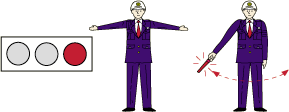
Question 21. No signal is required when a driver reverses their vehicle.
Question 22. The traffic sign shown in the figure prohibits vehicles from making U-turns.

Question 23. A flashing red traffic light mandates a stop at the designated line, with vehicles proceeding only after confirming safety.
Question 24. The traffic sign in the figure bans all traffic from passing through the road.

Question 25. Worn tires shorten braking distance due to a larger contact area with the road.
Question 26. When an obstacle blocks one side of the road, vehicles on that side must yield by stopping or slowing down for oncoming traffic.
Question 27. If a pedestrian is crossing near an intersection without a crosswalk, a vehicle should use the horn to warn them and continue.
Question 28. Vehicles must reduce speed on both steep uphill and downhill slopes.
Question 29. Overtaking is not permitted at or within 30 meters before a pedestrian crossing.
Question 30. In the situation shown in the figure, vehicle B may pass before vehicle A.
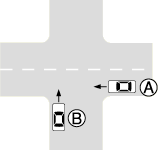
Question 31. The traffic sign in the figure indicates a student pedestrian crossing ahead.

Question 32. The traffic sign shown permits non-bus vehicles to use the lane when no buses are nearby or traffic is low, except for special light vehicles, mopeds, and light vehicles.

Question 33. After changing lanes, a driver should stop signaling about 3 seconds after completing the maneuver.
Question 34. The traffic sign in the figure mandates that general mopeds use a two-step right turn method.

Question 35. Vehicles are allowed to cross sidewalks or bicycle paths to enter or exit roadside areas.
Question 36. At a pedestrian or bicycle crossing, vehicles must stop immediately before the thick white line, if present.
Question 37. The pavement marking shown in the figure designates a zone where entry is prohibited.

Question 38. The traffic sign in the figure forbids vehicles from making right turns or proceeding straight through the intersection.

Question 39. In the lanes depicted in the figure, vehicles in lane A may move to lane B, but vehicles in lane B cannot move to lane A.
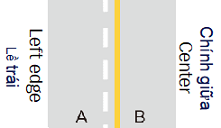
Question 40. A vehicle can pass a stopped streetcar if no passengers are boarding or alighting in the safety zone.
Question 41. Following the arrow in the figure is the correct way to enter a gas station on the right side of the road.
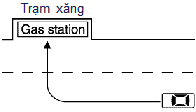
Question 42. A single driver or pedestrian ignoring traffic rules can cause confusion and potential accidents.
Question 43. General mopeds in Japan are restricted to a maximum speed of 30 km/h.
Question 44. A vehicle experiences a wheelbase differential when making left or right turns.
Question 45. When overtaking a bicycle to turn left, a driver may sound the horn to warn the cyclist and proceed.
Question 46. If a local bus at a stop signals to merge, other vehicles can pass by using the horn to alert it.
Question 47. Overtaking a vehicle that is passing a general sarguson moped is considered double overtaking.
Question 48. The traffic sign shown in the figure alerts drivers to an upcoming intersection.

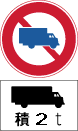
Question 49. The traffic sign in the figure prohibits trucks with a capacity of 2 tons or more and heavy special vehicles.
Question 50. The pavement marking shown in the figure marks the end of a 50 km/h speed limit zone.