Karimen exam no 13
30:00
Question 1. This sign indicates the center of the road or the center line.

Question 2. This sign indicates that the traffic restriction shown applies to the road ahead.
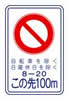
Question 3. Driving with an expired license is considered driving without a license.
Question 4. Overtaking a vehicle that is overtaking another regular car is considered double overtaking and is a violation.
Question 5. When lanes are separated by a yellow line, you must not cross the yellow line to change lanes.
Question 6. This sign indicates a steep uphill slope ahead.

Question 7. During a driver’s license renewal, tests for vision, hearing, and other aptitudes are conducted.
Question 8. On a dry road where the friction coefficient is higher, the stopping distance of a vehicle decreases.
Question 9. On a road with a white broken center line, you must not overtake by crossing into the right side of the road.
Question 10. Overtaking is prohibited in tunnels unless there are marked lanes.
Question 11. This sign prohibits passage of all light vehicles.

Question 12. If there is a change in the name or address listed on a driver’s license, it must be reported to the Public Safety Commission of the place of residence.
Question 13. The driver’s license point system exists, and if there have been no suspensions in the past three years, a license suspension occurs with 6 to 14 points.
Question 14. In the event of a traffic accident, reporting to the police takes precedence over preventing further accidents or aiding the injured.
Question 15. Even if more than one year has passed since obtaining a regular motorcycle license, a newly obtained large motorcycle license requires one year before carrying a passenger.
Question 16. The stopping position at a location with this sign is 3 meters before the sign.

Question 17. The validity period of an international driver’s license is three years from the issuance date.
Question 18. Police cars, fire trucks, and ambulances are emergency vehicles, but emergency work vehicles are not included.
Question 19. If you have a motorized bicycle license, you can drive a small special vehicle.
Question 20. When driving a bus or taxi for repositioning without passengers, a second-class license is not required.
Question 21. This sign prohibits pedestrian passage, and a motorized bicycle cannot pass even if the engine is off and it is being pushed.

Question 22. When visibility is poor due to fog, it is better to drive with low beam headlights as high beams worsen visibility.
Question 23. Parking is prohibited within 3 meters of a fire alarm.
Question 24. At an intersection with three or more lanes in the direction of travel and traffic signals, a motorized bicycle must perform a two-stage right turn unless a two-stage right turn prohibition sign is present.
Question 25. Signals for left turns, right turns, or U-turns should be given 30 meters before the location.
Question 26. This sign prohibits passage of large trucks, large special vehicles, and specific medium trucks.

Question 27. The braking distance is the distance from feeling danger and pressing the brake pedal until the brakes start to take effect.
Question 28. The maximum load capacity for a motorized bicycle is 60 kg.
Question 29. When passing a tram boarding area equipped with barriers for passengers, you only need to drive slowly through.
Question 30. You must drive slowly on a steep uphill slope.
Question 31. This sign prohibits vehicles from proceeding in directions other than the arrow.

Question 32. Loading or unloading cargo is considered stopping if within 5 minutes, and parking if exceeding 5 minutes.
Question 33. Even in a no-U-turn zone, U-turns are allowed within an intersection.
Question 34. The signal for changing lanes should be given 3 seconds before the change.
Question 35. Parking or stopping is prohibited within 5 meters of the edge of a roadwork zone.
Question 36. This sign indicates a pedestrian crossing.

Question 37. When overtaking another vehicle, you must confirm that the location is not a no-overtaking zone.
Question 38. Parking or stopping is generally prohibited on highways.
Question 39. When driving past a school bus stopped to pick up or drop off children, you must come to a complete stop.
Question 40. You do not need to drive slowly near a road curve if visibility is good.
Question 41. This sign indicates a dedicated lane where only designated vehicles, small special vehicles, motorized bicycles, and light vehicles can pass.

Question 42. When applying emergency brakes in a vehicle with ABS, it is best to press the pedal fully and hold it to activate the ABS.
Question 43. Parking or stopping is prohibited on highways, but temporary stopping is allowed if unavoidable.
Question 44. Overtaking is when a vehicle changes its path to move ahead of a vehicle in front.
Question 45. A motorcycle suitable for the rider’s physique is one where both toes touch the ground when straddling it.
Question 46. This sign prohibits passage of all vehicles, including motorized bicycles and light vehicles.
