Honmen exam no 9
Question 1. When a vehicle breaks down on a highway, it is permissible to park or stop on a wide shoulder or roadside strip if available.
Question 2. It is a traffic violation for a licensed driver to operate a vehicle without carrying their driver’s license or personal number card with license information.
Question 3. At night, when passing an oncoming vehicle, you must dim your headlights or switch them to low beam.
Question 4. When overtaking on a highway, it is permissible to temporarily exceed the speed limit.
Question 5. While driving, it is better to avoid sudden braking except when necessary to avoid danger.
Question 6. When applying both front and rear brakes on a motorcycle, use the rear brake more strongly on slippery surfaces like snowy roads, and the front brake more strongly on dry surfaces.
Question 7. When inspecting a motorcycle, you must check whether the brake play is appropriate, the handlebars are not heavy, the wheels are free of wobble or distortion, and the wires are not caught.
Question 8. Since motorcycles are highly maneuverable, it is permissible to weave between cars or drive in a zigzag pattern.
Question 9. Before getting into a car, it is sufficient to check for people or objects in front and behind the vehicle; there is no need to check under the car.
Question 10. Although overtaking was prohibited by signs, a slow-moving vehicle was ahead, so I changed lanes, passed it, and moved ahead.
Question 11. On roads with a roadside strip, even where parking or stopping is allowed, you must leave at least 0.5 meters of space for pedestrians.
Question 12. In the event of a major earthquake, when leaving a vehicle on the road, it is best to park it on the left side, lock the doors to prevent theft, and take the ignition key when evacuating.
Question 13. When traffic lanes are marked with yellow lines, you may change lanes across the yellow line if you confirm the safety of the rear and sides.
Question 14. When an emergency vehicle approaches while driving through or near an intersection, you must avoid the intersection, pull over to the left side of the road, and stop temporarily.
Question 15. The friction between tires and the road surface does not change with road conditions, so braking always stops the vehicle in the same distance.
Question 16. At an uncontrolled intersection (excluding roundabouts) where roads are of similar width, a tram was approaching, but I proceeded because vehicles on the left have priority.
Question 17. This sign indicates that there is a railway crossing ahead.

Question 18. If a vehicle breaks down at a railway crossing, it is best to first move the vehicle and then press the railway crossing obstruction warning device.
Question 19. On a road with three lanes in the same direction, I drove an ordinary car and continued in the third lane from the left.
Question 20. Since traffic is low at night, it is permissible to park in the same spot for 8 hours or more (except on roads in certain village areas).
Question 21. On a road with traffic lanes, I intended to change lanes and confirmed that the distance to the vehicle behind was sufficient, so I changed lanes without signaling.
Question 22. On highways, cargo vehicles must use the climbing lane regardless of whether they are carrying a load.
Question 23. If a tire punctures while driving, it is best to firmly grip the steering wheel, correct the vehicle’s direction, and press the brake hard to stop.
Question 24. When towing a broken-down vehicle with a rope or crane, a towing license is required.
Question 25. Near highway entrances where traffic information boards are present, you can obtain information about traffic jams or accidents, which helps predict future traffic conditions and is useful in emergencies.
Question 26. Vehicle owners must secure a storage place for their vehicles but must not use the road as a storage place.
Question 27. After overtaking on a highway, when moving in front of the overtaken vehicle, keep the left turn signal on, and once part of the overtaken vehicle is visible in the side mirror, quickly change lanes to return to the left lane.
Question 28. When applying emergency brakes unavoidably, it is best to press the clutch pedal and brake pedal simultaneously.
Question 29. When braking a motorcycle, keep the body upright, do not turn the handlebars, and apply both front and rear brakes simultaneously while using the engine brake.
Question 30. When slowing down or stopping, it is sufficient to signal when you intend to perform the action.
Question 31. When driving on snowy roads, the stopping distance is longer than on dry asphalt roads, so you should always drive at a moderate speed.
Question 32. If you understand the basics of driving, an automatic car is less dangerous than a manual car, so you can drive it with a casual attitude.
Question 33. In the case of a traffic accident with injuries, until a doctor or ambulance arrives, perform possible first aid measures, such as stopping bleeding with a clean handkerchief or gauze.
Question 34. To safely navigate a curve, it is better to sufficiently reduce speed on the straight section before the curve rather than slowing down during the curve.
Question 35. You cannot operate a vehicle without compulsory automobile liability insurance or mutual aid, but mopeds can be driven without such insurance.
Question 36. When borrowing someone else’s car to drive, you must check whether the vehicle inspection certificate is valid and whether compulsory insurance is in place.
Question 37. Although less than a year had passed since receiving my regular driver’s license, I was embarrassed to display the beginner’s mark, so I attached it in a less visible position on the vehicle and drove.
Question 38. When riding a motorcycle, considering the possibility of a fall, it is best to wear clothing that minimizes body exposure.
Question 39. For a motorcycle, it is sufficient to reduce speed when approaching a curve or corner.
Question 40. An ordinary car with a displacement of 660cc or less can be driven with a large special vehicle license.
Question 41. Even on roads with this sign, vehicles can pass through when there are few pedestrians.

Question 42. At an intersection with traffic signals and three or more lanes, where there is no two-stage right-turn sign for general mopeds, you can proceed to the right-turn point by keeping to the left.

Question 43. This sign indicates no parking.

Question 44. A vehicle’s stopping distance is divided into reaction distance and braking distance; reaction distance is proportional to speed, and braking distance is proportional to the square of speed.
Question 45. Parking or stopping is prohibited near the top of an uphill or on a steep downhill, but not on a steep uphill.
Question 46. When overtaking, the vehicle ahead may not notice and may veer toward you, so it is necessary to maintain sufficient lateral distance to avoid contact.
Question 47. Since overtaking is dangerous, when a vehicle behind attempts to overtake, it is best to accelerate to prevent being overtaken.
Question 48. You must not overtake or pass a general moped within 50 meters before a pedestrian crossing or bicycle crossing.
Question 49. On pedestrian-only roads, only specifically permitted vehicles can pass, and in such cases, drivers must take extra care of pedestrians and drive slowly.
Question 50. On roads with this sign, buses with a capacity of 30 or more passengers cannot pass, but microbuses can.

Question 51. On a rainy day, when braking on a steel plate at a construction site, applying sudden brakes allows for safer stopping.
Question 52. On highways where the maximum speed is not specified by signs or markings, minicars and general motorized bicycles cannot pass, but other vehicles can.
Question 53. Where there is a school zone sign, there are schools, kindergartens, or nurseries nearby, so you must pass with caution.
Question 54. When overtaking a car or general motorized bicycle, a vehicle must pass on the left side.
Question 55. When a police officer directing traffic at an intersection gave a 'stop' hand signal, I stopped just before the stop line.
Question 56. On snow-covered roads, there are often hidden dangers, so it is advisable to travel in the tracks of other vehicles.
Question 57. When the traffic light ahead is green, cars can go straight, turn left, or turn right, but there are intersections where general motorized bicycles can go straight or turn left but cannot turn right.
Question 58. At night, when approaching an intersection or curve with poor visibility, reduce to a safe speed and either switch the headlights to high beam or flash them to alert other vehicles or pedestrians of your approach.
Question 59. Parking or stopping within 5 meters before or after a pedestrian crossing or bicycle crossing is prohibited because it obscures pedestrians or cyclists, creating a dangerous situation.
Question 60. Paying attention to the surroundings can be distracting and dangerous, so novice drivers, being inexperienced, should focus on a single point ahead.
Question 61. Drivers must follow the instructions given by a police officer regarding traffic procedures or other matters.
Question 62. As long as drivers follow traffic rules, there is no need to worry about causing accidents, so there is no particular need to drive with consideration.
Question 63. When riding a motorcycle at night, it is advisable to wear reflective clothing or a helmet with reflective materials.
Question 64. Parking or stopping is prohibited within 10 meters of a bus stop sign or pole during bus operating hours.
Question 65. While driving in a lane designated for priority passage of route buses by road signs, I changed to another lane when a kindergarten bus approached from behind.
Question 66. This sign indicates that vehicles can go straight or turn left but cannot turn right.

Question 67. Removing a motorcycle's muffler increases noise but boosts power, so it is better to drive without a muffler.
Question 68. The creep phenomenon in an automatic car refers to the vehicle slowly moving forward even without pressing the accelerator pedal if the brake pedal is not firmly pressed.
Question 69. On a well-maintained mountain road, there is no risk of the ground loosening or collapsing on a rainy day, so it is permissible to drive on the shoulder.
Question 70. Persons aged 20 or older who have held a large or ordinary motorcycle license for at least 3 years can carry a passenger on a large or ordinary motorcycle on highways, except in prohibited areas.
Question 71. Car drivers must anticipate the actions of pedestrians and cyclists and drive with sufficient caution regarding their movements.
Question 72. Even during the daytime, headlights must be turned on in places like tunnels or dense fog where visibility is less than 50 meters (or 200 meters on highways).
Question 73. When the rear wheels skid due to sudden acceleration or sharp steering, it is best to turn the steering wheel in the opposite direction of the skid.
Question 74. While driving down a long slope, if the brakes fail, I pressed the brake pedal several times, quickly downshifted, and pulled the handbrake.
Question 75. A car equipped with seat belts cannot be driven with a person (except in cases exempted by law) not wearing a seat belt in the passenger seat next to the driver, but only on highways.
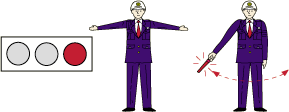
Question 76. The three signals shown in the figure, by traffic lights or a police officer, have the same meaning for oncoming traffic.
Question 77. When towing a broken-down vehicle with a rope, a person with a license for the towed vehicle must hold and operate its steering wheel.
Question 78. On highways, as a guideline for following distance, when the road is dry and tires are new, maintain a distance at least equal to the speed in kilometers per hour (e.g., 100 meters at 100 km/h).
Question 79. If a vehicle is towed due to illegal parking, the driver or owner must bear the costs of towing and storage.
Question 80. People must not ride in the cargo bed of a truck, but when carrying cargo, the minimum number of people necessary to watch the cargo can ride in the cargo bed while driving.
Question 81. In a tunnel without designated vehicle lanes, you must not change course or pass the side of the vehicle ahead to overtake.
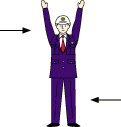
Question 82. This police officer’s hand signal has the same meaning as a yellow traffic light for the direction indicated by the arrow.
Question 83. The impact force of a car collision increases the shorter the duration of the impact, such as when hitting a hard object.
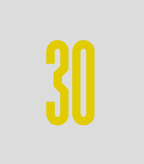
Question 84. On roads with this marking, you must not drive at a speed exceeding 30 kilometers per hour.
Question 85. There is a close relationship between a car’s speed and fuel consumption; both excessively high and low speeds increase fuel consumption.
Question 86. Tire inspection involves checking air pressure, cracks or damage, abnormal wear, the presence of foreign objects like stones or metal pieces, and sufficient tread depth.
Question 87. When attempting to reverse, if pedestrians or other vehicles are approaching, you must not reverse as it may cause an obstruction.
Question 88. If the vehicle is ready to be driven immediately, loading or unloading cargo within 5 minutes is considered stopping, not parking.
Question 89. The inner wheel difference refers to the 'play' in the steering wheel when it is turned left or right.
Question 90. Since motorcycles tend to fixate on nearby points, it is important to look ahead, observe everything, and accurately gather information.
Question 91. You are driving at 40 km/h. What should you pay attention to while driving?
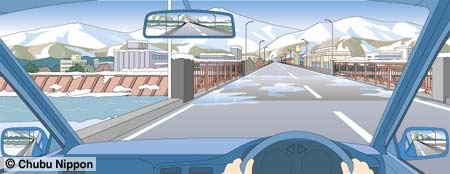
1. Bridges are prone to icing, so reduce speed sufficiently before the bridge to prepare for slipping.
2. On a straight road with no oncoming vehicles and no apparent danger, continue at the same speed.
3. There may be a risk of slipping on the bridge, so reduce speed and avoid sudden braking or sharp steering while passing.
Question 92. You are driving at 40 km/h. What should you pay attention to while driving?
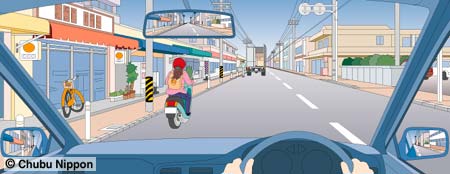
1. The moped is aware of my vehicle’s approach and will likely stop before the parked vehicle to yield, so I continue driving as is.
2. The moped might move in front of my vehicle, so I follow the moped until passing the parked vehicle.
3. Since there are no oncoming vehicles, I accelerate to overtake the moped and parked vehicle at once.
Question 93. You are driving at 30 km/h. What should you pay attention to when turning left at an intersection following the vehicle ahead?
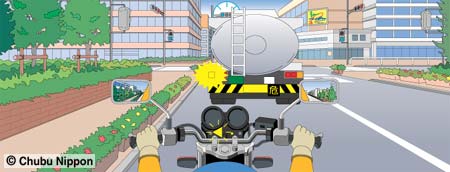
1. Large vehicles make wide turns and take time when turning left, so I slip through on the left to turn left first.
2. Since the situation inside the intersection is not visible, I steer to the right and turn left from the right side of the large vehicle.
3. Since it’s unclear what dangers may be hidden behind the large vehicle, I reduce speed, confirm safety, and then turn left.
Question 94. You are driving at 30 km/h. What should you pay attention to while driving?
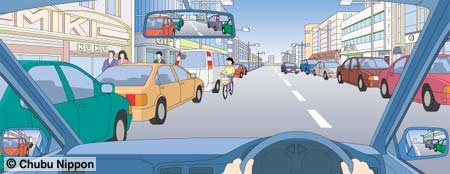
1. People may suddenly emerge from between parked vehicles, causing oncoming vehicles to cross the centerline, so I pay attention to their movements.
2. A bicycle may wobble and move toward the center of the road, so I pay attention to its movements.
3. Passing an oncoming vehicle and a bicycle at the same time is dangerous, so I accelerate to pass the bicycle first.
Question 95. You are driving at 30 km/h. What should you pay attention to while driving?
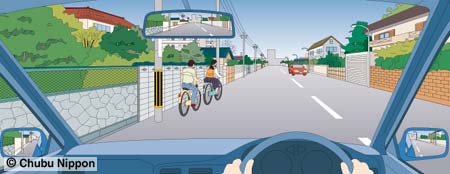
1. Continuing as is would not allow safe lateral clearance from both the bicycle and oncoming vehicle, so I avoid overtaking the bicycle until the oncoming vehicle has passed.
2. If I hurry, I believe I can overtake the bicycle before the oncoming vehicle approaches, so I accelerate to pass.
3. The cyclist is aware of my vehicle’s approach and will likely continue in a straight line, so I overtake as is.