Honmen exam no 8
Question 1. This sign indicates that the road ahead narrows.

Question 2. When driving a four-wheeled vehicle and the engine RPM rises and doesn’t decrease due to a malfunction, it’s best to shift to neutral and immediately turn off the engine.
Question 3. The novice driver period refers to the one-year period after obtaining an ordinary car license, mid-sized truck license, large motorcycle license, ordinary motorcycle license, or moped license, depending on the license type.
Question 4. This sign indicates that you can turn left regardless of the traffic signal ahead.

Question 5. When parking on a highway due to a breakdown on a sufficiently wide shoulder or roadside strip, turning on hazard lights or tail lights is enough, and a stop sign is not needed.
Question 6. When photochemical smog due to air pollution is occurring or expected, you should refrain from driving.
Question 7. When choosing a motorcycle, I couldn’t set the center stand on flat ground but could push it in a figure-eight, so I thought it suited my physique and chose this model.
Question 8. While driving in an urban area and a major earthquake warning was issued, fearing buildings might collapse and crush the car, I stopped in the center of the road instead of the left and locked the doors to evacuate.
Question 9. When leaving the vehicle, if it’s only for a short time, there’s no need to turn off the engine.
Question 10. When completing a right or left turn, the signal should be turned off about 3 seconds after the action is completed.
Question 11. On a road where there is less than 3.5 meters of space on the right side of the vehicle, the driver stopped for 10 minutes with someone in the vehicle to wait for a person.
Question 12. Vehicles must be registered and equipped with a license plate.
Question 13. The bicycle crossing zone and the area within 5 meters before and after it are designated as no-parking or no-stopping zones.
Question 14. On mountain roads after prolonged or heavy rain, the ground may become loose and collapse, so be careful not to pull over too close to the shoulder.
Question 15. When an emergency vehicle approached but it wasn’t near an intersection, I pulled to the left side of the road to yield.
Question 16. At an unregulated intersection with vehicle lanes (except roundabouts), when an ordinary motorcycle makes a right turn, it’s best to gradually move toward the center of the road beforehand.
Question 17. The correct riding posture for a motorcycle is to keep the back straight and focus the gaze on a single point.
Question 18. Vehicles must not cross or make a U-turn where signs or markings prohibit it, even if there are no pedestrians or other vehicles.
Question 19. A person with an ordinary license for less than a year must display a “novice driver” mark in the designated position when driving an ordinary passenger car, but not when driving an ordinary truck.
Question 20. People using vehicles for the disabled, walking with guide dogs, or holding white or yellow canes are physically impaired, so drivers must stop temporarily or slow down to ensure their safe passage.
Question 21. Except when towing a broken-down vehicle, towing a vehicle with a total weight exceeding 750 kg requires a towing license in addition to the driver’s license for the towing vehicle.
Question 22. This sign prohibits vehicle entry, meaning you cannot enter from the direction of the sign.

Question 23. Motorcycles are highly maneuverable and agile, so even when the vehicle ahead is changing lanes to make a right turn, you can overtake it.
Question 24. When riding a motorcycle, it’s best to wear clothing that minimizes body exposure to protect against falls.
Question 25. When turning left at an intersection, there is a blind spot to the rear left from the driver’s seat, so you must take great care to avoid collisions with pedestrians or cyclists.
Question 26. The height limit for cargo on general mopeds or large motorcycles (excluding those with sidecars) is 2 meters or less from the ground.
Question 27. For motorcycle brakes, it’s best to use the engine brake and apply the front and rear brakes separately.
Question 28. The maximum speed for large trucks on national highways is 90 km/h, so they cannot use the overtaking lane.
Question 29. On roads with vehicle lanes where signs or markings designate lanes by direction, you must follow the designated lanes except in cases like approaching emergency vehicles or unavoidable circumstances.
Question 30. When overtaking, sudden acceleration or sharp steering to change lanes can cause loss of control or skidding, so great care is needed.
Question 31. When intending to turn left at an intersection ahead (except roundabouts), you must move to the left edge of the road just before turning and make the left turn.
Question 32. Although I lost my driver’s license, since I am still qualified, I can drive without getting a reissued license until it’s found.
Question 33. Motorcycle drivers must understand the structural characteristics of motorcycles and not let their guard down just because they are easy to handle, always driving cautiously.
Question 34. When there are two vehicle lanes in the same direction, you can travel in either lane.
Question 35. On a highway, when trying to merge from the acceleration lane to the main road but a vehicle was stopped in the acceleration lane, I passed on the left roadside strip to merge first.
Question 36. On the main road, acceleration lane, deceleration lane, or climbing lane, if you cannot drive due to a breakdown, fuel depletion, or traffic accident, you must call 110 to contact the police, use a nearby emergency phone to call a tow truck, and promptly move from these areas.
Question 37. The stopping distance of a vehicle is determined by the speed and force of braking, regardless of road or tire conditions.
Question 38. When riding a motorcycle on muddy or gravel roads, it’s best to use the highest gear and rely on momentum to get through.
Question 39. On a road other than an intersection, at a place with a pedestrian crossing, when a police officer signals with hand or light in yellow or red, the stopping position is 1 meter before the officer.
Question 40. When needing to decelerate on the main highway, shift to a lower gear, use the engine brake, and apply the foot brake in multiple stages.
Question 41. The signal for reversing is to turn on the reverse light or extend an arm outside the vehicle diagonally downward, palm facing backward, and move the arm back and forth.
Question 42. When the vehicle ahead is changing lanes to the right to make a right turn, you must not overtake on its right side.
Question 43. When driving at high speeds, the driver’s field of vision narrows, and dynamic visual acuity is particularly reduced.
Question 44. At an intersection and within 30 meters before it, unless on a priority road, you must not change lanes or pass alongside to overtake other cars or general mopeds.
Question 45. Even if stopping continuously in a no-parking zone, it is not considered parking if the driver is in the vehicle.
Question 46. When driving through a curve or corner, it’s best to significantly decelerate in the middle of the curve.
Question 47. On a road with a roadside strip, where stopping or parking is allowed, you must leave at least 0.5 meters of space for pedestrians.
Question 48. On flat, straight snowy or icy roads, if equipped with studded tires or tire chains, the vehicle will not slip or skid sideways.
Question 49. There was a person crossing the pedestrian crossing, but when the vehicle approached, they stopped, so I continued driving.
Question 50. Such a police officer’s hand signal has the same meaning as a red traffic light for the direction of the arrow.
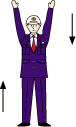
Question 51. At places with parking meters or parking ticket dispensers, if you activate the parking meter or obtain a parking ticket and display it in a visible spot on the front of the vehicle, you can park for the time indicated by the sign.
Question 52. When closing a car door, to prevent it from being half-closed, it’s best to close it firmly in one go without stopping midway.
Question 53. When the vehicle ahead is large, it may obstruct your view and cause you to miss signals, so it’s best to maintain a greater following distance than usual.
Question 54. When the headlights of an oncoming vehicle are dazzling, it’s best to shift your gaze slightly to the left front to avoid being blinded.
Question 55. When there were pedestrians in the safety zone, I slowed down to pass through.
Question 56. Not only sudden acceleration, abrupt braking, or revving the engine, but also keeping the engine idling during continuous stops causes extra fuel consumption.
Question 57. If a child seat is chosen or used incorrectly, it not only loses its effectiveness but may also cause harm.
Question 58. When riding a motorcycle through a curve, it’s best to sufficiently decelerate on the straight section before the curve and then make the turn.
Question 59. Near the crest of an uphill slope, you must not overtake the vehicle ahead, even if it is traveling slowly.
Question 60. Even if a traffic accident occurs and you are not at fault but the other party is, there is no obligation to report it to the police.
Question 61. When driving an automatic vehicle, before starting the engine, it’s important to visually confirm the positions of the brake and accelerator pedals to avoid pressing the wrong one.
Question 62. The stopping distance is the sum of the free-running distance and the braking distance.
Question 63. On highways, mini-cars, ordinary motorcycles with a displacement of 125cc or less, and general mopeds are not allowed to travel.
Question 64. When the vehicle skids sideways due to sudden acceleration or sharp steering, do not use the brakes, but ease off the accelerator and steer to realign the vehicle.
Question 65. In a traffic accident where the victim has a head injury, if there is no risk of accidents from following vehicles, it’s better not to move the victim.
Question 66. When the hand signals of a police officer or traffic patrol officer differ from the traffic light signals, follow the traffic light signals.
Question 67. You don’t need to wear a seatbelt when driving a vehicle equipped with airbags.
Question 68. You must not carry people in the cargo area of a truck, even for the purpose of watching over cargo.
Question 69. After installing tire chains, drive a short distance and then check if they are securely attached.
Question 70. When the intersecting road is a priority road or wider (except at roundabouts), you must slow down to avoid interfering with vehicles traveling on the intersecting road.
Question 71. Slow driving means moving at a speed where the vehicle can stop immediately, with the specific speed varying depending on the vehicle type and load condition.
Question 72. The rectangular auxiliary sign below this main sign indicates the section where the traffic regulation shown by the main sign applies.
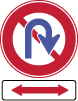
Question 73. If you have a large vehicle license, you can drive a large special vehicle.
Question 74. When driving down a long slope and the brakes fail, make every effort to stop the vehicle by rubbing the wheels against the hillside, scraping against guardrails, or driving into roadside gravel.
Question 75. When stopping a vehicle, to avoid rear-end collisions, apply the brakes in stages, extend an arm diagonally downward outside the vehicle to signal stopping, and always pay attention to the movements of following vehicles.
Question 76. This sign indicates that vehicles (including cargo) with a height exceeding 3.3 meters from the ground are not allowed to pass.

Question 77. When overtaking the vehicle ahead, you must maintain sufficient distance from it.
Question 78. When a vehicle is stuck on a railway crossing, you must immediately notify the train driver and move the vehicle off the crossing.
Question 79. On roads with this sign, large and ordinary motorcycles are prohibited from carrying two people.

Question 80. At night, visibility is poor, but traffic is generally lighter, so driving with the same caution as during the day is sufficient.
Question 81. On the main highway, stopping or parking is not allowed except for temporary stops to prevent danger.
Question 82. The vehicle lane with this sign is exclusively for route buses and school buses; other vehicles must not use it.

Question 83. Drivers are required not only to have driving skills and knowledge but also, as members of society, to show consideration for other road users.
Question 84. When riding a motorcycle on the left side of congested traffic, be cautious as pedestrians may suddenly dart out or the door of the vehicle ahead may open abruptly.
Question 85. When inspecting lighting devices or turn signals, check not only their illumination or blinking but also the cleanliness and damage of the lenses.
Question 86. Automatic vehicles may have higher engine RPM immediately after starting or when the air conditioner is on, posing a risk of sudden acceleration.
Question 87. When there is a vehicle stopped at a pedestrian crossing or bicycle crossing zone, I slowed down and checked for safety before passing alongside it.
Question 88. When braking on a motorcycle, to avoid leaning forward, it’s best to lean your body backward.
Question 89. When passing an oncoming vehicle or following another vehicle, you must dim the headlights or switch to low beams.
Question 90. Vehicles facing this signal can proceed straight after a temporary stop at the stop line, but cannot turn right or left.
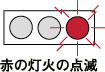
Question 91. Driving at 40 km/h. What should you pay attention to while driving?
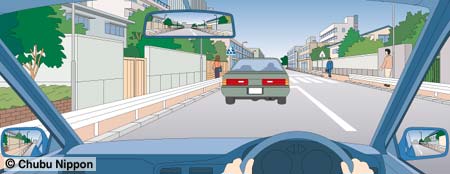
1. The vehicle ahead may suddenly stop to yield to pedestrians, so maintain a safe following distance.
2. Pedestrians may cross after the vehicle ahead passes, so reduce speed to be able to stop immediately.
3. There are no following vehicles, and pedestrians will likely cross after my vehicle passes, so continue as is.
Question 92. Driving at 40 km/h. What should you pay attention to while driving?
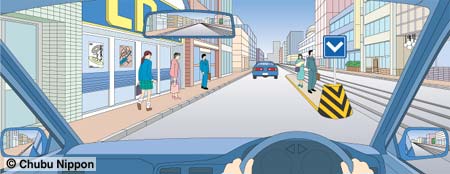
1. Pedestrians on the left may cross to the safety zone in front of my vehicle, so reduce speed to stop immediately and watch their movements.
2. There are pedestrians in the safety zone, and it’s unclear if they will cross, so proceed at a speed where you can stop immediately.
3. There are pedestrians in the safety zone, but they show no signs of crossing, so continue at the current speed.
Question 93. Driving at 30 km/h. What should you pay attention to while driving?
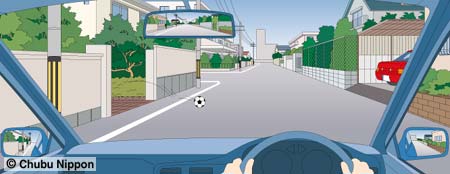
1. The ball is likely to roll to the right side of the road, so move to the left edge and continue at the current speed.
2. Children may run after the ball and dart into the road, so reduce speed to be able to stop immediately.
3. To prevent children from chasing the ball and running into the road, sound the horn and continue passing.
Question 94. Driving at 40 km/h. The road ahead is icy. What should you pay attention to while driving?
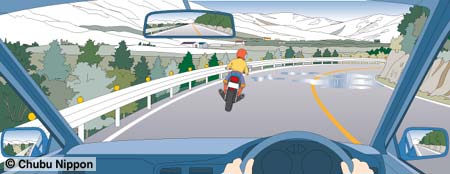
1. Motorcycles may slip and fall, so reduce speed and observe the situation.
2. The icy road may cause slipping, so avoid sharp steering or sudden braking.
3. Motorcycles may notice the icy road and brake suddenly, so reduce speed and maintain a safe following distance.
Question 95. Driving at 50 km/h. What should you pay attention to while driving?
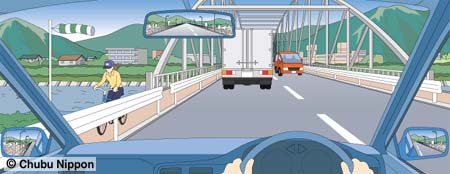
1. Bridges are susceptible to wind, so reduce speed and take care not to lose control of the steering while passing.
2. If strong winds cause the vehicle to veer, immediately steer sharply to correct the course.
3. Surrounding vehicles may sway due to wind, so pay attention to their movements.