Honmen exam no 7
Question 1. On a highway, when unavoidably parking on the shoulder or roadside due to a breakdown, you must place a stopping indicator in a location clearly visible to drivers approaching from behind.
Question 2. While driving and changing lanes to the left in the same direction, the signal should be given when you start turning the steering wheel.
Question 3. Vehicles must not overtake cars or general motorized bicycles within 30 meters before a pedestrian crossing or bicycle crossing.
Question 4. On rainy days, when windows fog up and impair visibility, it’s advisable to slightly open the side windows to let in outside air or turn on the air conditioner to clear the fog.
Question 5. When witnessing a hit-and-run, you should assist the injured and report the vehicle’s license plate number, type, color, and other characteristics to the police via 110.
Question 6. When riding a motorcycle in hot weather, exposing more of the body reduces fatigue and leads to safer driving.
Question 7. Immediately after starting an automatic car’s engine or when the air conditioner is on, the engine RPM increases, but it is automatically adjusted, so there is no risk of sudden acceleration.
Question 8. Motorcycles traveling on the left edge of the road may move toward the center to avoid obstacles like drains, road bumps, or puddles, so caution is required.
Question 9. Using a handheld mobile phone while driving is dangerous, so it’s advisable to turn off the phone or switch to driving mode before driving to prevent ringtones or other sounds.
Question 10. When a pedestrian signal is marked “Pedestrians and Bicycles Only,” both specific small motorized bicycles and bicycles must follow that signal.
Question 11. If you lend a vehicle to someone who is drunk or unlicensed, the vehicle owner or the person who lent it will also be penalized.
Question 12. On the road, a traffic patrol officer was directing traffic with hand signals, but since they were not a police officer, I did not follow those signals.
Question 13. The stop line marked before an intersection or pedestrian crossing is a guide for stopping, so it’s permissible to stop slightly beyond it.
Question 14. Motorcycle braking methods include the front brake using the lever, the rear brake using the pedal, and engine braking by easing the throttle or shifting to a lower gear.
Question 15. At night, when parking or stopping on the road, even if visible from 50 meters behind due to streetlights, you must always turn on hazard lights, parking lights, or tail lights.
Question 16. Road markings are lines, symbols, or characters marked on the road surface with paint or studs, and they are divided into two types: regulatory markings and instructional markings.
Question 17. This sign prohibits large and ordinary motorcycles from carrying two people.

Question 18. When turning left from a one-way road at an intersection ahead (except roundabouts), you must keep to the left edge of the road in advance and proceed slowly along the intersection’s edge.
Question 19. When checking a motorcycle’s chain, with the center stand up, press the middle of the chain with your finger; it should be just right if it feels overly tight.
Question 20. When an earthquake occurred, I stopped the vehicle on the shoulder, turned off the engine, and locked the doors to prevent theft before evacuating.
Question 21. This sign indicates that there is a wide intersection ahead.

Question 22. When I should have gone straight at the intersection ahead, I mistakenly signaled a left turn but continued straight without turning off the indicator.
Question 23. If a vehicle gets stuck on a railway crossing, use a flare or other means to signal the train as quickly as possible.
Question 24. At a railway crossing, for safety, you must stop just before the crossing (or at the stop line if present), but at a crossing with good visibility, you can pass slowly.
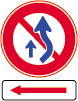
Question 25. This sign indicates the start of a section where overtaking by crossing to the right is prohibited.
Question 26. The seatbelt’s lap belt should be worn loosely around the abdomen.
Question 27. When riding a motorcycle on a gravel road, use a low gear and reduce speed to proceed.
Question 28. On snowy or icy roads, you need to skillfully use engine braking and foot braking.
Question 29. The D position of an automatic car’s gear lever has low engine braking effect, and continuous braking in this position may cause vapor lock, rendering the brakes ineffective.
Question 30. The correct riding posture for a motorcycle is to place the arch of the foot on the peg, with the left toe under the shift pedal for easy operation at any time.
Question 31. Even if the lanes before an intersection are marked with a yellow line, you may cross the yellow line to change lanes for a right or left turn at the intersection.
Question 32. At the junction of a highway’s main road, if a sign designates the main road ahead as having priority, you must not obstruct vehicles traveling on that main road.
Question 33. When a vehicle carries heavy cargo, the weight improves braking efficiency and shortens the stopping distance.
Question 34. When attempting to overtake, if you feel even slight unease about road conditions, traffic, vehicle performance, or driving skills, it’s best to cancel the maneuver.
Question 35. When turning right or left at an intersection, the inner wheel difference increases with larger vehicles, so extra caution is needed when driving a large vehicle and turning left.
Question 36. When a vehicle stops continuously for loading or unloading cargo, it is always considered parking.
Question 37. When signs or markings indicate a maximum speed of 30 km/h or less, you must not drive faster than this speed.
Question 38. The higher the speed, the greater the centrifugal force affecting the vehicle, making it harder to drive, with a higher risk of losing control or skidding sideways.
Question 39. When driving with a young child to shop nearby, a child seat is not necessary.
Question 40. The driver must check the safety of the rear when opening the vehicle door or getting out.
Question 41. Near toll booth gates on highways, to pass quickly, choose an empty lane and frequently change lanes.
Question 42. When unavoidably parking on a highway, enter the roadside strip and stop along the left edge of the road.
Question 43. Even with a sports-type general motorized bicycle, if driven by someone with a standard or large motorcycle license, it can travel on highways.
Question 44. Vision decreases when moving suddenly from a bright to a dark place, but it does not change when moving from a dark to a bright place.
Question 45. When passing through an intersection with poor visibility, you may miss other vehicles or pedestrians suddenly appearing, so you need to proceed slowly and cautiously.
Question 46. Driving an automatic car requires understanding the basics, following procedures, and operating accurately.
Question 47. While driving on a highway, if cargo falls and needs to be removed, use the emergency phone to request its removal.
Question 48. At dusk, it can suddenly get dark, and vision remains impaired until your eyes adjust, so turn on the headlights early.
Question 49. Where there is no pedestrian crossing, vehicles have priority over pedestrians crossing.
Question 50. When getting in or out of a car in heavy traffic, it’s better to use the left-side door.
Question 51. You must not throw objects onto the road or direct blinding light toward the road.
Question 52. While driving, instead of focusing on one point, it’s better to vaguely observe the surroundings.
Question 53. When riding a motorcycle through a curve, disengage the clutch when entering the curve and shift gears to accelerate in the latter half of the curve.
Question 54. When the vehicle ahead is changing lanes to the right to make a right turn, overtaking on the right is dangerous and prohibited.
Question 55. When the foot brake fails, all brakes become ineffective, so using the hand brake has no effect.
Question 56. While driving, even if there are clearly no pedestrians at a crossing, you must slow down or stop when approaching the crossing.
Question 57. When driving a borrowed vehicle, since it’s not your own, it’s not an issue if the vehicle inspection certificate has expired or it lacks mandatory insurance.
Question 58. While waiting to merge from the acceleration lane to the main road but finding no gap, I drove on the shoulder to merge.
Question 59. When choosing a motorcycle, even though my toes didn’t touch the ground when seated, I chose a larger one thinking it would be more stable.
Question 60. Vehicle owners must report the storage location of the vehicle to the police chief.
Question 61. Knowledge of natural forces like friction or centrifugal force acting during driving is not directly necessary for riding a motorcycle.
Question 62. If you have a large special vehicle license, you can also drive an ordinary car.
Question 63. Even when leaving the vehicle for a short time, to prevent danger, you must turn off the engine and engage the hand brake.
Question 64. This sign indicates that vehicles with a width, including cargo, exceeding 2.2 meters cannot pass.

Question 65. Those who remove a motorcycle’s muffler or modify the handlebars to a deformed shape are subject to penalties.
Question 66. When the intersecting road ahead is a priority road, you must slow down and not obstruct vehicles or trams traveling on that road.
Question 67. When the left side of the road is congested, you can travel on the right side from the centerline.
Question 68. When a four-wheeled vehicle has a tire puncture while driving, first hold the steering wheel firmly and correct the vehicle’s direction.
Question 69. You must not overtake an ordinary car displaying a learner’s or novice driver’s sign.
Question 70. Drunk driving is extremely dangerous due to risks of misjudgment, oversight, or operational errors and must absolutely be avoided.
Question 71. The cargo weight of a truck may exceed the maximum load specified in the vehicle inspection certificate by up to 10%.
Question 72. When being overtaken by another vehicle, if there isn’t enough space for overtaking, you must move as far left as possible and yield the way.
Question 73. High-speed driving reduces the time to approach other vehicles, pedestrians, or road obstacles, leaving no margin to avoid accidents.
Question 74. Tire pressure must be balanced on both sides, or it may cause loss of control or uneven tire wear.
Question 75. This sign indicates that the road ahead is winding, requiring careful driving.

Question 76. The left side of a safety zone and within 10 meters before and after it are no-parking or stopping zones.
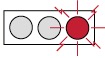
Question 77. Vehicles or trams facing this signal can enter the intersection slowly while paying attention to other traffic.
Question 78. Motorcycles are highly maneuverable, but weaving between cars or zigzagging is not only extremely dangerous but also causes anxiety for surrounding drivers.
Question 79. On rainy days, when pedestrians along the road or in front of shops use umbrellas to avoid mud splashes, you don’t need to slow down.
Question 80. Having gone the wrong direction on the highway, I made a U-turn at a gap in the median strip.
Question 81. Overtaking near a road curve is dangerous due to the risk of collision with oncoming vehicles or cyclists/pedestrians emerging from behind them, so it is prohibited.
Question 82. When trying to overtake the vehicle ahead, it didn’t notice and suddenly changed lanes to the right, so I had to sound the horn to prevent danger.
Question 83. When traveling on highways, you must carry emergency signal devices or stopping indicators, but they are not required on regular roads.
Question 84. Applying the front brake of a motorcycle may cause a fall, so it should only be used for emergency stops.
Question 85. When driving through or near an intersection and an emergency vehicle approaches, you must avoid the intersection, move to the left side of the road, and slow down to yield.
Question 86. A driver’s license or license information card must be readily available to present immediately when requested by a police officer while driving.
Question 87. When passing a child walking alone, you must not only slow down but always stop temporarily.
Question 88. When a traffic accident occurs, the driver must report to the police the accident location, number and extent of injuries, degree of property damage, and cargo on the accident vehicle, and follow instructions.
Question 89. This marking indicates that you must not stop within this area.

Question 90. At night, visibility is poor, and the gaze tends to focus far ahead, so it’s best to concentrate on driving just in front of the vehicle.
Question 91. You are driving at 30 km/h. What should you pay attention to while driving?
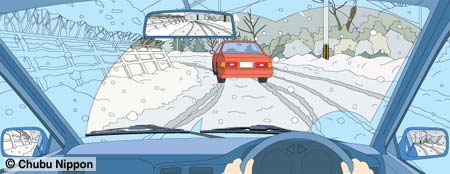
1. When an oncoming vehicle approaches, sudden steering is dangerous, so drive as close to the left edge of the road as possible.
2. Tracks left by other vehicles (ruts) have hardened snow and are slippery, so drive on the snow-covered parts.
3. My vehicle is equipped with studded tires and tire chains, so I drive the same as on normal road conditions.
Question 92. You are driving at 40 km/h. What should you pay attention to when going straight through an intersection?
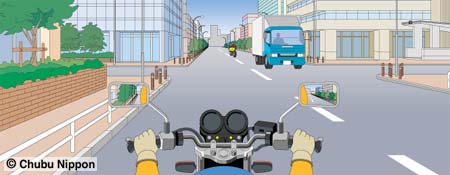
1. The oncoming motorcycle might turn right first, so slow down and observe.
2. The oncoming right-turning motorcycle should yield to my vehicle, so I continue driving.
3. The oncoming motorcycle might be trying to overtake a truck, so slow down and move to the left.
Question 93. You are driving at 30 km/h. What should you pay attention to while driving?
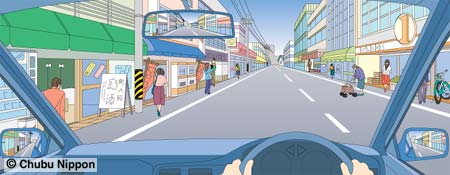
1. An elderly person might not notice my approaching vehicle and continue crossing, so stop temporarily to yield.
2. The elderly person will notice my vehicle and stop, so I accelerate to pass without making them wait.
3. It takes time for the elderly to cross, so I pass at the current speed.
Question 94. You are driving at 50 km/h. What should you pay attention to while driving?
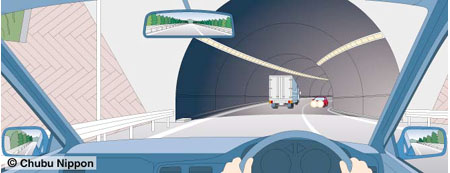
1. An oncoming vehicle blinded by glare might cross the centerline, so slow down and drive to the left.
2. The vehicle ahead might suddenly slow down due to tunnel pressure, so maintain a safe following distance.
3. Right after entering a tunnel, eyes aren’t adjusted to the darkness, so drive close to the vehicle ahead using its taillights as a guide.
Question 95. You are driving at 40 km/h. What should you pay attention to while driving?
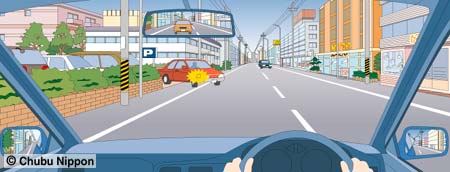
1. The vehicle trying to exit the parking lot will notice my vehicle and reverse, so I continue driving.
2. The vehicle exiting the parking lot might try to merge in front of oncoming traffic, so slow down and yield.
3. Sudden braking might cause a rear-end collision, so brake gently multiple times, gradually slow down, and yield to the vehicle on the left.