Honmen exam no 6
Question 1. On the main carriageway of an expressway, the legal speed limit for ordinary vehicles (excluding three-wheeled vehicles) is 100 km/h for passenger cars and 80 km/h for cargo vehicles.
Question 2. When entering the main carriageway from the acceleration lane, you should drive slowly.
Question 3. An emergency vehicle was approaching the intersection, but since the traffic signal in the direction of travel was green, I entered the intersection without yielding.
Question 4. Vehicles are prohibited from crossing over the center of the road (or the center line, if present) to the right side, regardless of road conditions or other traffic.
Question 5. When closing the car door after getting in, it is best to pause slightly before closing it firmly.
Question 6. When parking or stopping on a road with a roadside strip, if the strip is 0.75 meters or less in width, you must stop along the roadway.
Question 7. A vehicle displaying a novice driver mark was driving slower than the maximum speed limit, so I sounded the horn to make it move to the left side of the road and passed.
Question 8. When riding a motorcycle, position your feet in an inverted V-shape with your toes under the brake pedal.
Question 9. Since ordinary motorcycles are highly maneuverable, when making a right turn (except at roundabouts), it is better to change course from the left lane to near the center line in as short a distance as possible.
Question 10. When the vehicle ahead is stopped or driving slowly at an intersection or railway crossing, you must not cut in front or cross in front of it.
Question 11. At night, it is best to look far ahead to quickly detect and avoid obstacles.
Question 12. Driver's licenses are classified into three types: first-class driver's license, second-class driver's license, and provisional driver's license.
Question 13. You do not need to drive slowly near road curves if visibility is good.
Question 14. When you see someone in trouble due to a traffic accident or breakdown, it is important to cooperate by contacting authorities or providing assistance.
Question 15. When loading cargo onto an ordinary cargo vehicle, it may protrude up to one-tenth of the vehicle's length from both the front and rear.
Question 16. Engine braking provides greater braking force in lower gears.
Question 17. Overtaking is prohibited within 30 meters of a bus stop.
Question 18. When operating the gear lever of an automatic vehicle, failing to firmly press the brake pedal may cause sudden acceleration or reversing.
Question 19. In areas where passage is prohibited under the Disaster Countermeasures Basic Act, if a vehicle obstructs emergency vehicles, the driver may be ordered by a police officer to take necessary measures.
Question 20. While driving on a highway, using the white line on the left as a guide and staying slightly to the left of the lane helps maintain sufficient space for overtaking vehicles, preventing collisions.
Question 21. At a location other than an intersection, with no crosswalk, bicycle crossing, or railway crossing, when a police officer raises both arms parallel, vehicles facing the officer must stop 1 meter before them.
Question 22. When riding a motorcycle and the engine RPM rises and does not decrease, it is best to continue driving with the clutch partially engaged.
Question 23. This sign indicates a priority lane for route buses, and other vehicles must promptly leave the lane when a route bus approaches.

Question 24. When passing near pedestrians, specific small mopeds, or bicycles, you must always drive slowly, even if there is a safe distance.
Question 25. A person aged 20 or older who has held an ordinary motorcycle license for at least 3 years can carry a passenger on a highway.
Question 26. When overtaking a tram, you must pass on its left side.
Question 27. When riding a motorcycle on muddy or gravel roads, it is best to avoid braking or large steering movements and control speed with the throttle.
Question 28. When entering a dark tunnel from a bright area, visibility decreases sharply, so reduce speed before entering the tunnel.
Question 29. If the wheels spin on muddy or gravel roads, it is best to shift to a low gear and accelerate quickly without using anti-slip measures.
Question 30. If the driver's license or license information record card specifies 'glasses, etc.' in the conditions section, this includes the use of contact lenses.
Question 31. When driving a vehicle, it is important to respect the perspective of pedestrians and other drivers, and to have a spirit of courtesy and consideration, rather than being self-centered.
Question 32. Overtaking requires a long distance, so it is important to accurately judge the distance and time needed for overtaking.
Question 33. This sign indicates that parking is prohibited from 8 a.m. to 8 p.m.

Question 34. The distance from when the driver applies the brakes after sensing danger until the vehicle stops is called the stopping distance.
Question 35. When passing through areas with poor visibility due to thick fog or blizzards, it is necessary to turn on headlights to alert other traffic of your presence and use the horn as needed to prevent danger.
Question 36. When leaving the vehicle, it is best to put the gear in reverse on flat ground or downhill slopes and in low gear on uphill slopes.
Question 37. When starting a vehicle, it is not necessary to signal with the turn indicator.
Question 38. When passing a stopped vehicle, doors may open suddenly or people may jump out from behind, so it is best to proceed at a safe speed and manner.
Question 39. To safely stop a motorcycle quickly, use the front brake as an auxiliary and apply the rear brake as strongly as possible.
Question 40. An ordinary passenger car with a seating capacity of 5 can carry 3 adults and 3 children under 12 years old.
Question 41. When riding a motorcycle with the engine off down a slope, you may use the roadside strip.
Question 42. On roads with designated lanes, you must not straddle two lanes except in unavoidable circumstances.
Question 43. This sign indicates that there is a traffic signal ahead.

Question 44. At an intersection, when the traffic signal in your direction is flashing red, you must stop temporarily, check the intersection's safety, and then proceed.
Question 45. This marking indicates that parking or stopping within the roadside strip is prohibited, and light vehicles are also not allowed to pass through.
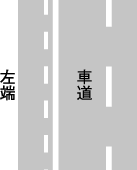
Question 46. Since motorcycles naturally turn when tilted, there is no need to reduce speed on any curve.
Question 47. The responsibility for a traffic accident lies solely with the driver who caused it, and the owner who carelessly lent the vehicle has no responsibility.
Question 48. When being overtaken by another vehicle, you must not increase speed until the overtaking is complete.
Question 49. When passing through an intersection (except roundabouts), you must proceed with caution for pedestrians or vehicles entering, using the safest possible speed and method.
Question 50. This sign indicates that changing course for overtaking is a violation.
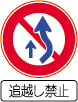
Question 51. While driving on a highway, stopping on the main carriageway or suddenly changing course due to confusion about the destination is dangerous, so planning ahead is essential.
Question 52. When parking in a time-restricted parking zone with a parking meter, it is best to activate the parking meter within 5 minutes.
Question 53. A small amount of alcohol can relieve tension and sharpen the mind, so it is okay to drink while driving to reduce fatigue.
Question 54. Motorcycles maintain stability through the rider's body while moving but lose stability when stopped, a structural characteristic fundamentally different from four-wheeled vehicles.
Question 55. When making a right turn at an intersection (except roundabouts), if a motorcycle is coming straight from the opposite direction, your vehicle has priority, so you can turn right first.
Question 56. This marking indicates that there is an intersection ahead.

Question 57. When turning a curve, centrifugal force acts due to the vehicle's inertia, and if the speed doubles, the centrifugal force doubles.
Question 58. The main carriageway of a highway does not include acceleration or deceleration lanes.
Question 59. This sign indicates that you can proceed slowly after confirming safety.

Question 60. While driving in a residential area and approaching a blind alley, I sounded the horn and passed through.
Question 61. Parking is prohibited where fire hydrants or firefighting water signs are present or within 5 meters of the intake of a firefighting water tank.
Question 62. On rainy days, there are fewer pedestrians and vehicles, and other drivers are more cautious, so the level of danger is lower than on clear days.
Question 63. A child seat does not need to be used in unavoidable cases, such as illness.
Question 64. When a vehicle breaks down on a highway, stop on the roadside strip and, for safety, evacuate to a safe place instead of staying in the vehicle.
Question 65. When tires are worn, the friction between the tire and the road decreases, increasing the braking distance but not affecting the free-running distance.
Question 66. There are three types of braking methods for motorcycles: using the brake lever, using the brake pedal, and using engine braking.
Question 67. When passing through a railway crossing, drive slightly toward the center to avoid wheel drop.
Question 68. An ordinary driver's license allows driving only ordinary vehicles and general mopeds.
Question 69. On roads with low traffic, a vehicle with a faulty foot brake can still be driven using engine braking and the hand brake.
Question 70. When a vehicle stops for loading or unloading cargo, it is always considered stopping.
Question 71. When turning right or left at an intersection with low traffic (except roundabouts), it is acceptable to signal just before the turn.
Question 72. Crashing into a concrete wall at 60 km/h results in an impact force equivalent to falling from a height of about 14 meters (approximately a 5-story building).
Question 73. Since many accidents occur during twilight, turn on your lights early to make your vehicle’s presence known.
Question 74. This sign indicates that stopping is prohibited.

Question 75. The hydroplaning phenomenon refers to air bubbles entering the brake fluid, causing the brakes to fail.
Question 76. You must not park or stop parallel to a vehicle already parked or stopped (double parking/stopping).
Question 77. When turning left, checking for potential entrapment with the rearview mirror is sufficient, and there is no need to drive slowly.
Question 78. Being busy with work and short on time, I watched a favorite TV program on the car TV while driving.
Question 79. A school bus with flashing emergency lights was stopped on the road ahead, but thinking children wouldn’t jump out immediately, I passed by at the same speed without slowing down.
Question 80. The creep phenomenon in automatic vehicles refers to the vehicle moving slowly forward when the gear lever is shifted to any position other than 'P' or 'N' without pressing the accelerator pedal.
Question 81. While driving, obeying traffic rules is fundamental for safe road use, but if you are confident you won’t cause an accident, it’s not always necessary to follow them.
Question 82. At night in busy urban areas, drive with low-beam headlights, and when oncoming vehicle lights are dazzling, shift your gaze slightly to the left front to avoid being blinded.
Question 83. If cargo cannot be divided and exceeds weight, size, or loading method regulations, you can obtain permission by reporting to the police station chief at the point of departure.
Question 84. On a road with no houses around, there is no danger, so it is okay to throw objects out of the vehicle.
Question 85. Since motorcycles have two brake systems—front and rear—you can drive to a repair shop even if one fails.
Question 86. When approaching a crosswalk, unless it is clear there are no pedestrians crossing, you must proceed at a speed that allows stopping before the crosswalk.
Question 87. When riding a motorcycle for short distances or with frequent mounting and dismounting, it is not necessary to wear a helmet.
Question 88. During the day, when unavoidably parking on a general road, place a stop indicator behind the vehicle or open the trunk to alert other vehicles of the parked vehicle’s presence.
Question 89. When a pedestrian is crossing a road without a crosswalk, it may be unavoidable to obstruct their crossing.
Question 90. When passing through a railway crossing, it is sufficient to stop just before the crossing (or at the stop line, if present) and check left and right safety with your own eyes.
Question 91. You are driving at 30 km/h. What should you pay attention to when going straight through an intersection?
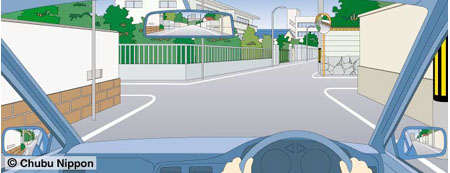
1. Since visibility at the intersection is poor, reduce speed to a level where you can stop at any time.
2. Since nothing is reflected in the curve mirror and the left side is safe, proceed while paying attention only to the right side.
3. Since no other traffic is visible ahead, continue driving at the same speed.
Question 92. You are driving at 20 km/h. What should you pay attention to when turning left at an intersection?
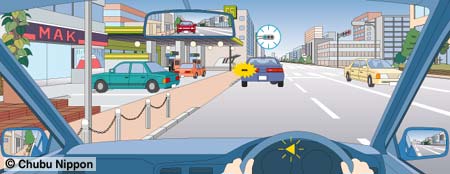
1. Assuming the vehicle ahead will also turn left at the intersection, approach closely and turn left.
2. The vehicle ahead may suddenly slow down to enter a gas station, so tap the brakes several times to alert following vehicles and avoid a rear-end collision.
3. Since it’s unclear whether the vehicle ahead will enter a gas station or turn left at the intersection, reduce speed and maintain a safe distance.
Question 93. You are driving at 20 km/h. What should you pay attention to while driving?
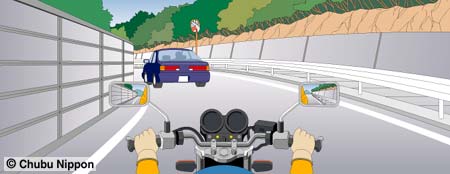
1. The vehicle ahead may suddenly stop due to an approaching oncoming vehicle, so maintain a safe distance and watch its movements.
2. Since your vehicle is a motorcycle with excellent maneuverability and can pass through narrow gaps, pass between the vehicle ahead and the wall.
3. The vehicle ahead may reverse to allow an oncoming vehicle to pass, so stop in place and observe the situation.
Question 94. You are driving at 30 km/h. What should you pay attention to while driving?
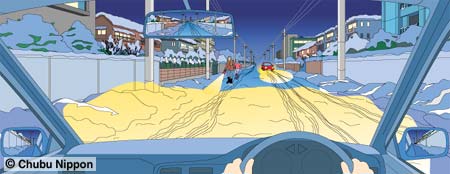
1. A pedestrian may slip and fall, so gradually reduce speed and stop before reaching the pedestrian.
2. Trying to avoid a pedestrian quickly may cause slipping, so stop temporarily, let oncoming vehicles pass, and then slowly move to the right to avoid the pedestrian.
3. Assuming the pedestrian will notice your vehicle and move aside, continue driving while watching for oncoming vehicles.
Question 95. You are driving at 60 km/h on a highway acceleration lane. What should you pay attention to when merging onto the main carriageway?
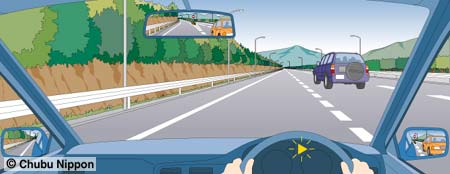
1. There is a gap in traffic on the main carriageway to the right, so merge immediately to avoid missing the opportunity.
2. A vehicle is approaching from behind on the main carriageway, so adjust your speed to merge behind it.
3. There may be a vehicle in the mirror’s blind spot, so check safety visually before merging.