Honmen exam no 5
Question 1. When stopping or parking on a road at night, if the area 50 meters behind is clearly visible due to road lighting, etc., it is not necessary to turn on hazard lights, parking lights, or tail lights.
Question 2. A parked two-wheeled vehicle may start moving even if it knows another two-wheeled vehicle is approaching from behind, so when driving a two-wheeled vehicle and noticing a parked vehicle ahead, you should first move close to the center of the road, accelerate, and pass.
Question 3. When passing through deep water, water may enter the brake drum, causing the brakes to malfunction, but there is no need to avoid puddles as the water will dry due to brake heat.
Question 4. A fixed-route bus is traveling in a designated bus lane, but since an emergency vehicle is approaching, you entered the bus lane to yield to the emergency vehicle.
Question 5. The height limit for cargo on motorized bicycles and regular two-wheeled motorcycles (except tricycles) is 2 meters or less from the ground.
Question 6. The approach to a bicycle crossing area should generally be considered the same as approaching a pedestrian crossing.
Question 7. Highways have better road conditions than regular roads, so driving for long periods will not cause excessive fatigue, and frequent rest is unnecessary.
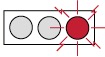
Question 8. Vehicles and trams facing this signal may proceed slowly into the intersection while paying attention to other traffic.
Question 9. Vehicles must not overtake cars or motorized bicycles at railway crossings or within 30 meters before them.
Question 10. In addition to having knowledge of necessary first aid measures for traffic accidents, you should keep triangular bandages, gauze, and medical tape in the vehicle for emergencies.
Question 11. When braking both the front and rear wheels of a two-wheeled vehicle, brake harder with the rear brake on slippery surfaces like snow, and harder with the front brake on dry surfaces.
Question 12. You can determine if the tire tread depth is sufficient by checking the wear indicator (slip mark) on the tire's sidewall.
Question 13. If a vehicle stalls at a railway crossing, calmly attempt to restart the engine; if unsuccessful, as an emergency measure, shift to a low gear or second gear and use the starter motor to move the vehicle (this method cannot be used for vehicles with automatic transmissions, etc.).
Question 14. When a traffic accident occurs, the driver must report to the police the accident location, number of injuries, injury severity, property damage, and cargo details, and await instructions.
Question 15. When changing lanes, etc., you must confirm safety using mirrors, etc., and anticipate vehicles in areas not visible in the mirrors.
Question 16. For vehicles with automatic transmissions, fully pressing the accelerator while driving will automatically shift to a lower gear, allowing sudden acceleration.
Question 17. Illegal abandonment of a vehicle is creating a state where the vehicle cannot be driven immediately due to the driver leaving the vehicle in a prohibited parking area.
Question 18. This sign indicates the 'end' of a no-parking zone.

Question 19. Traffic signs consist of main signs and auxiliary signs indicating traffic regulations, etc.
Question 20. When driving at night, switching the headlights to low beam is dangerous because it limits forward visibility, so you should not use low beam even when passing oncoming vehicles.
Question 21. You must not stop in the designated no-stopping area in front of a fire station, but you may enter and stop in a no-stopping area if it is not a fire station.
Question 22. The retention area symbol issued by the police chief can be attached anywhere on the vehicle.
Question 23. When driving in a swampy or wet area, even if mud or water splashes, the driver is not responsible if driving slowly.
Question 24. You must check for insufficient coolant or leaks in the cooling system, as these can cause overheating on highways, which is dangerous.
Question 25. Even though overtaking is prohibited by a sign, etc., since a slow-moving car is ahead, you changed lanes, passed alongside, and moved ahead.
Question 26. While driving a car, you looked closely at the phone screen to read an email.
Question 27. When mounting a two-wheeled vehicle, if the toes of one foot can lightly touch the ground and support the vehicle, it can be considered suitable for the rider's build.
Question 28. This sign indicates that the road ahead is curved, so caution is needed when driving.

Question 29. When pressing the brake pedal and it feels light, air may have entered the brake hose or there may be a brake fluid leak.
Question 30. In the case of a 'temporary stop' sign without a stop line, the stopping position is just before the intersection.
Question 31. When towing two broken-down vehicles, use a 5-meter rope for the first vehicle and a 10-meter rope for the second.
Question 32. The vehicle's exhaust pipe was damaged, but since it did not affect driving, you continued to drive as is.
Question 33. The engine brake of an automatic transmission vehicle is less effective, so use the foot brake and hand brake when going downhill.
Question 34. If you have a large vehicle license, you can drive large special vehicles.
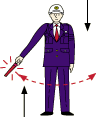
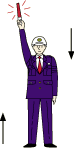
Question 35. The police hand signal as shown has the same meaning for the direction of the arrow.
Question 36. Many accidents occur at dusk, so turn on the headlights early to signal your vehicle's presence.
Question 37. The 0.5-meter area from the left edge of a road without a sidewalk or shoulder is considered the 'roadside,' so vehicles must not drive toward it.
Question 38. When parking in a time-limited parking area with a parking ticket machine, you must immediately activate the parking ticket machine.
Question 39. To carry a passenger on a large or regular two-wheeled motorcycle, you must first be proficient in riding alone.
Question 40. In unavoidable cases such as breakdowns on highways, stopping or parking on the shoulder or a sufficiently wide roadside is permitted.
Question 41. When overtaking on a highway, use the right lane and quickly return to the original lane after overtaking.
Question 42. When riding a bicycle at night, it is not necessary to turn on the front or rear lights, but you must wear reflective materials.
Question 43. When turning right at an intersection, you must temporarily stop even if there are no oncoming vehicles or pedestrians.
Question 44. Regular vehicle maintenance and inspection are the driver's responsibility, and neglecting inspection will result in legal penalties.
Question 45. On highways without a specified speed limit, the maximum speed is 100 kilometers per hour.
Question 46. In dense fog, even turning on the headlights cannot ensure visibility, so you should avoid driving.
Question 47. When parking a vehicle, if there is a sidewalk, you may drive onto the sidewalk to park.
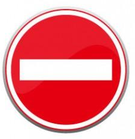
Question 48. This sign indicates that vehicle entry is prohibited.
Question 49. When turning left at an intersection, pay attention to pedestrians and cyclists and stop temporarily if necessary.
Question 50. When gripping the steering wheel, if you place your thumbs on the inside of the wheel, sharply turning it may injure your wrist.
Question 51. At an intersection, when a police officer raises their arm vertically while directing traffic, it has the same meaning as a yellow traffic light for traffic moving parallel to the officer's body.
Question 52. When turning through a curve on a two-wheeled vehicle, leaning the vehicle may cause lateral skidding, so you should turn by steering the handlebars without leaning.
Question 53. In principle, high-speed vehicles must drive close to the center of the road on roads without designated lanes.
Question 54. When intending to park, even if there is less than 3.5 meters of space on the right side of the vehicle, you parked because no other vehicles were passing.
Question 55. Maintaining a safe following distance helps prevent rear-end collisions.
Question 56. You may drive on the shoulder to overtake a vehicle ahead.
Question 57. You may sound the horn whenever necessary while driving.
Question 58. You may drive a vehicle with alcohol in your system.
Question 59. The smaller the radius of a curve, the greater the centrifugal force.
Question 60. This sign indicates 'proceed slowly,' and vehicles must move at a speed allowing immediate stopping.

Question 61. If a two-wheeled vehicle is about to fall off a cliff, you should give up and let it fall.
Question 62. When turning right at an intersection, you must not obstruct vehicles going straight or turning left.
Question 63. Three children under the age of 12 are counted as two adults for seat capacity calculations.
Question 64. Children may become engrossed in objects they are interested in or suddenly dart onto the road, so drivers must be especially cautious when children are present.
Question 65. Uneven tire pressure between the left and right sides can cause loss of steering control or tire deviation to one side.
Question 66. Even if a vehicle with a low maximum speed is overtaking, you must not accelerate until it has completely passed, but you do not need to yield.
Question 67. This sign indicates a no-stopping or no-parking zone.
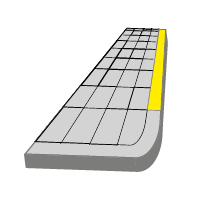
Question 68. For the riding position on a two-wheeled vehicle, you should extend both elbows horizontally and sit as far forward as possible.
Question 69. On a road with good visibility and a width of less than 6 meters on the left side, you may cross to the right side from the center to overtake, except when overtaking is prohibited by signs or instructions or when there is oncoming traffic.
Question 70. At railway crossings and within 10 meters before and after them, parking is prohibited but stopping is allowed.
Question 71. When a driver is fatigued, it takes longer to recognize danger and make judgments, increasing the stopping distance.
Question 72. When overtaking another vehicle on a highway, you may temporarily exceed the maximum speed limit.
Question 73. The driver mistakenly signaled a left turn when intending to go straight at an intersection but proceeded straight without turning off the signal.
Question 74. Vehicle speed and fuel consumption are closely related; the faster the speed, the less fuel is consumed.
Question 75. Understanding natural forces such as friction and centrifugal force during driving is useful for preventing traffic accidents.
Question 76. This sign indicates that vehicles must not travel below 30 km/h.

Question 77. On straight, flat snowy or icy roads, if the vehicle is equipped with snow tires or tire chains, it will not skid or slide laterally.
Question 78. While driving in a lane designated by a traffic sign for priority vehicles like fixed-route buses, you changed lanes because a school bus approached from behind.
Question 79. When loading cargo on a two-wheeled motorcycle or motorized bicycle, cargo protruding up to 15 cm on both sides from the cargo bed is allowed.
Question 80. For two-wheeled vehicles with automatic transmissions, fully releasing the throttle at low speeds may cause the engine power not to transfer to the wheels, leading to instability.
Question 81. The hydroplaning phenomenon occurs when air bubbles enter the brake fluid, causing the brakes to fail.
Question 82. When overtaking a vehicle ahead, you must pass on its right side, except when the vehicle ahead intends to change lanes to the right.
Question 83. When the traffic signal flashes yellow, you must temporarily stop and proceed slowly.
Question 84. Two-wheeled vehicles are highly maneuverable, making sharp turns easy, so during traffic congestion, the rider can weave between vehicles.
Question 85. This sign indicates that the intersecting road ahead is a priority road when driving on a road with this sign.

Question 86. Even if you cannot drive the vehicle immediately due to being away for urgent business, you may stop in a no-stopping or no-parking zone if you can return quickly.
Question 87. The braking distance is the distance from when the brakes begin to take effect until the vehicle stops.
Question 88. Vehicle users should consider voluntary vehicle insurance to prepare for unfortunate incidents.
Question 89. Signaling a lane change too early may inconvenience other vehicles, so turning the steering wheel immediately after signaling is the safest method.
Question 90. Users of vehicles with an abandonment confirmation sticker may be required by the Public Safety Commission to pay a fine for illegal abandonment.
Question 91. The oncoming lane is congested. What should you pay attention to when driving in this situation?
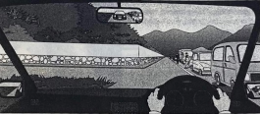
A pedestrian appeared from between the congested vehicles, but I think they will notice my vehicle and yield, so I will continue driving.
I think the two-wheeled vehicle ahead will turn right into the alley on the left, so I will press the brake pedal several times to signal the vehicle behind and warn of stopping.
Other pedestrians may dart out, or doors of oncoming vehicles may open, so I will be cautious while driving.
Question 92. You are stopped at an intersection waiting to turn right. What should you pay attention to when driving?
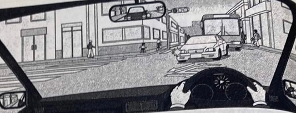
I think the bus will not move immediately because it is blocked by a passenger vehicle in the oncoming direction, so I will quickly turn right first.
I think the bus will wait for my vehicle to turn right, and there is a vehicle behind, so I will quickly turn right.
Since I cannot see the situation behind the bus, I will turn right after the bus has passed and I have confirmed safety.
Question 93. At night, you have reduced your speed to 10 km/h to turn right at an intersection. What should you pay attention to when driving in this situation?
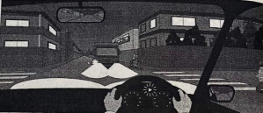
I think the bicycle will cross the pedestrian crossing on the right, so I will temporarily stop near the center of the intersection and wait for the bicycle to pass.
Since the situation ahead is unclear due to the oncoming vehicle blocking visibility, I will move forward slightly, stop temporarily, and confirm safety for two-wheeled vehicles, etc., coming from the blind spot of the oncoming vehicle.
The pedestrian crossing on the right is outside the range illuminated by my vehicle's headlights, so I will carefully confirm the entire crossing.
Question 94. You are driving at 30 km/h while heading straight toward an intersection. What should you pay attention to when driving?
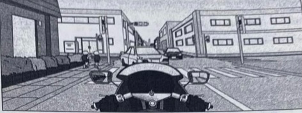
The vehicle ahead may suddenly stop at the pedestrian crossing, so I will pull to the right and maintain speed while driving.
Since an oncoming vehicle may turn right before noticing my vehicle due to being obscured by the vehicle ahead, I will pay attention to its actions while driving.
Since the situation at the intersection is unclear, I will stop temporarily at the pedestrian crossing.
Question 95. You are driving through an area with beautiful scenery. What should you pay attention to when driving?
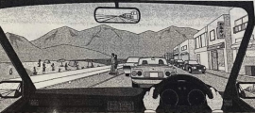
The vehicle ahead may suddenly stop to admire the scenery, so I will reduce speed while driving.
People may dart out from between parked vehicles, so I will be cautious while driving.
Focusing on the brake lights of the vehicle ahead while driving to avoid being distracted by the scenery.