Honmen exam no 16
Question 1. Driving involves repeated actions of perception, judgment, and operation, requiring constant effort to anticipate dangers and prevent traffic accidents.
Question 2. When intending to overtake, if you feel even slightly uneasy due to road conditions, traffic, vehicle performance, or driving skills, you should stop attempting to overtake instead of forcing it.
Question 3. For two-wheeled vehicles, their structural characteristic is maintaining stability while moving but losing stability when stopped, fundamentally different from four-wheeled vehicles.
Question 4. This sign indicates that vehicles with a height exceeding 3.3 meters from the ground (including cargo height) are not allowed to travel.

Question 5. On a road designated as a priority lane for fixed-route buses, you did not enter the priority lane because there was a risk of not being able to exit when a fixed-route bus approached due to traffic congestion.
Question 6. When leaving the vehicle, if you remove the ignition key, the anti-theft device activates, and the steering wheel locks, so you may not need to lock the doors.
Question 7. When approaching a pedestrian crossing, you must stop if pedestrians are crossing, but you may proceed slowly if pedestrians are about to cross.
Question 8. In case of a breakdown on a highway, you must pull over to the shoulder, take necessary measures to prevent danger, and wait in a safe location away from the vehicle.
Question 9. When entering a tunnel while driving, if you turn on the headlights first, you do not need to reduce speed.
Question 10. When driving a car, you must have a valid vehicle inspection certificate and liability insurance or liability support certificate on board.
Question 11. When mounting a two-wheeled vehicle, place your feet in an inverted V-shape and insert your toes under the brake pedal.
Question 12. When turning right at an intersection with this instruction, you must follow the arrow markings.

Question 13. In an upright position with the kickstand, pressing the center of a two-wheeled vehicle's chain with your finger is better when the chain is taut rather than slack.
Question 14. Because the road is wide, you drove over the speed limit indicated on the sign.
Question 15. For a vehicle being towed due to a breakdown, a licensed person must be on board and operate the steering wheel.
Question 16. The time to signal when turning left is after completing the steering wheel turn.
Question 17. Use the L gear of an automatic transmission vehicle when driving on uphill or downhill slopes.
Question 18. When a two-wheeled vehicle follows a four-wheeled vehicle, the four-wheeled vehicle may change lanes without noticing the two-wheeled vehicle, so you must be cautious.
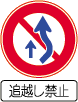
Question 19. At a location with this sign, you must not change lanes or pass alongside to overtake cars or motorized bicycles.
Question 20. When braking a two-wheeled vehicle, use the engine brake while simultaneously applying the front and rear brakes.
Question 21. When an emergency vehicle approaches on a one-way road, you must pull over to the right and yield.
Question 22. On a road with a shoulder, even in areas where parking and stopping are allowed, you must leave a clearance of at least 0.5 meters for pedestrians.
Question 23. To prevent someone from darting out from the blind spot of a stopped vehicle, carefully observe the roof and floor of the vehicle, etc.
Question 24. Because you overshot the intended exit at a highway junction, you confirmed safety behind and reversed to the junction.
Question 25. On steep downhill slopes, overtaking other vehicles is prohibited because it promotes acceleration and is dangerous.
Question 26. When selecting a child safety seat for a child in a car, choose one that can be securely fixed and suits the child's build.
Question 27. When dazzled by the headlights of an oncoming vehicle, close your eyes and shift your gaze elsewhere.
Question 28. On a road with this sign, there is oncoming traffic, so you must be cautious.

Question 29. When skidding laterally due to sudden acceleration or sharp steering, release the accelerator without using the brake and correct the vehicle's direction with steering.
Question 30. At a railway crossing, proceed continuously in a low gear to prevent stalling.
Question 31. When driving a regular two-wheeled motorcycle, if one year has passed since obtaining the license, you may carry a passenger even without a rear seat.
Question 32. Rearview and side mirrors are installed to assist with blind spots on a car.
Question 33. For an automatic transmission vehicle, if you confirm the gear is in P before starting the engine, you do not need to check the position of the brake and accelerator pedals.
Question 34. With a large two-wheeled vehicle license, you can drive large two-wheeled motorcycles, regular two-wheeled motorcycles, small special vehicles, and motorized bicycles.
Question 35. At an intersection with traffic lights, since no vehicles enter when the adjacent signal is red, you can start as soon as the intersecting road's signal turns red.
Question 36. Those who remove the muffler of a two-wheeled vehicle or modify it to a deformed steering wheel are subject to penalties.
Question 37. When traffic ahead is congested, you must not enter pedestrian crossings or railway crossings, but you may enter and stop in bicycle crossing areas.
Question 38. Within 5 meters from the start of a road construction area, parking is prohibited, but stopping is allowed.
Question 39. When passing pedestrians or bicycles, you must drive slowly even if you can maintain a safe distance.
Question 40. The main lane of a highway includes both the shoulder and the roadside.
Question 41. Two-wheeled vehicles are highly maneuverable and can navigate tight corners easily, so even if the vehicle ahead intends to change lanes to turn right, you can overtake it.
Question 42. When driving, even if leaning but driving comfortably, it is not dangerous.
Question 43. Since the impact force in a collision is proportional to the square of the speed, the danger increases with speed.
Question 44. This sign indicates that merging traffic ahead.

Question 45. When forced to stop or park due to a breakdown at night, you must turn on the hazard lights, parking lights, or tail lights.
Question 46. At an unregulated intersection with roads of equal width, you must not obstruct vehicles coming from the left.
Question 47. For the designated passenger capacity of a car, counting three children under 12 years old as equivalent to two adults is correct.
Question 48. When a person with a provisional license is driving a car, you must not drive closely alongside or unreasonably cut in front of that vehicle.
Question 49. When the engine overheats while driving, stop the vehicle immediately, remove the radiator cap, and add water.
Question 50. Driver's licenses are classified into three types: Class 1, Class 2, and provisional licenses.
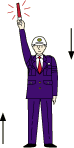
Question 51. When a police officer raises their arms as shown, it is equivalent to a yellow traffic light for traffic moving in the direction of the arrow.
Question 52. When going downhill on a two-wheeled vehicle with the engine stopped, you may travel on the shoulder.
Question 53. When checking lighting or turn signal devices, not only check their illumination and blinking status but also inspect for dirt or damage to the light lenses.
Question 54. Within 5 meters from the corner of a road, parking is allowed if it is for loading or unloading cargo within 5 minutes.
Question 55. The number on the sticker placed in the center of the front windshield indicates the validity period of the vehicle's liability insurance.
Question 56. A person aged 20 or older who has held a regular two-wheeled motorcycle license for more than 3 years may carry a passenger on highways.
Question 57. On a road where lanes are divided by a yellow line, drivers must not cross the yellow line to change lanes for turning left or right.
Question 58. The designated passenger capacity on a vehicle's inspection certificate does not include the driver.
Question 59. The stopping distance is not related to road conditions but is determined by speed and brake application intensity.
Question 60. This sign indicates that stopping is prohibited.

Question 61. When riding through mud on a two-wheeled vehicle, do not turn the handlebars; maintain a steady speed with the throttle and keep balance to proceed.
Question 62. When the vehicle ahead signals to pull to the left edge or center of the road to exit, you must not obstruct its lane change, except when avoiding danger.
Question 63. You may load up to 60 kg of cargo on the cargo bed of a large two-wheeled motorcycle or motorized bicycle.
Question 64. On a road with a 'school zone' sign, anticipate that children may suddenly dart out from behind parked vehicles, so you must be particularly cautious when driving.
Question 65. When forced to brake on a highway, use engine braking and press the brake pedal multiple times.
Question 66. On a slope, a vehicle going downhill must yield to a vehicle going uphill because starting uphill is difficult.
Question 67. Pedestrians, vehicles, and trams facing this signal may proceed while paying attention to other traffic.

Question 68. Not only the driver but also the passenger on a two-wheeled vehicle must wear a helmet designated for riding.
Question 69. On a road with three lanes in the same direction, if the rightmost lane is left open for overtaking, you may drive in any of the remaining lanes regardless of your vehicle's speed.
Question 70. All instances of stopping a vehicle for loading or unloading cargo are considered parking.
Question 71. Safe speed is the speed at which the driver can always control the vehicle safely, depending on the time, place, and situation.
Question 72. Ordinary passenger cars used for personal or family purposes must undergo periodic maintenance inspections once a year, and maintenance should be performed at appropriate times based on mileage and operating condition.
Question 73. On a narrow road, because the vehicle ahead suddenly reversed, you sounded the horn to draw attention and prevent danger.
Question 74. Vehicle speed and fuel consumption are closely related; fuel consumption increases when the speed is too slow or too fast.
Question 75. The reason for reducing speed before a curve is that maintaining high speed while turning or braking after entering the curve is dangerous due to the risk of rolling over or skidding laterally.
Question 76. A motorized bicycle turning right at an intersection with this sign must follow a two-stage right-turn method.

Question 77. The correct riding posture for a two-wheeled vehicle is to grip the fuel tank with both knees, place the arch of the foot on the footpeg so the sole is nearly horizontal with the ground, and point the toes forward.
Question 78. When turning right at a congested intersection, you may inch forward intermittently with oncoming traffic and turn right at the shortest distance.
Question 79. If the weight or size of the cargo or loading method exceeds regulations because the cargo cannot be divided, you should report it to the police chief at the destination.
Question 80. At pedestrian crossings, bicycle crossing areas, or within 30 meters before them, overtaking is prohibited but passing is allowed.
Question 81. Continuing to drive at high speed with low tire pressure can cause a standing wave phenomenon in the tires, which is dangerous, so slightly increase tire pressure.
Question 82. When proceeding ahead after overtaking a vehicle, turn on the left turn signal and continue until you can see the overtaken vehicle in your rearview mirror, then slowly move to the left after confirming safety.
Question 83. When the traffic light at an intersection turns yellow, although you could stop safely, you proceeded through while paying attention to the situation because a yellow signal does not mean 'stop.'
Question 84. Driving on rainy days is often dangerous due to slippery roads, but if you ensure proper steering and braking, accidents can be prevented, so the following distance and speed can be similar to sunny days.
Question 85. On a one-way road, you may drive on the right side from the center of the road.
Question 86. When checking engine oil levels and dirt, you look at the dipstick while keeping the engine running.
Question 87. A hand signal by the driver as shown indicates slowing down or stopping.

Question 88. The stopping distance of a vehicle consists of the free-running distance and braking distance; the free-running distance is proportional to speed, and the braking distance is proportional to the square of the speed.
Question 89. When someone sustains a head injury in a traffic accident, even if there is a risk of a secondary accident from vehicles behind, they should not be moved due to life-threatening concerns.
Question 90. You must not drive a car or motorized bicycle without liability insurance or liability support.
Question 91. If you have reduced your speed to 10 km/h, what should you pay attention to when driving through a railway crossing?
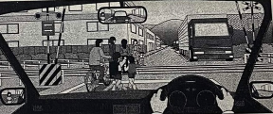
Since there are many bicycles and pedestrians on the left, I will stop just after pulling slightly to the left to pass a large oncoming vehicle.
In the railway crossing, bicycles may move to the right to avoid pedestrians, so I will quickly accelerate to pass through continuously.
If I go straight, I will have to pass through a narrow space between pedestrians and oncoming vehicles in the railway crossing, so I will follow behind the pedestrians.
Question 92. You are driving at 60 km/h on the acceleration lane of a highway. What should you pay attention to when driving?
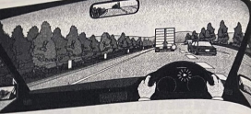
There is a vehicle ahead in the acceleration lane, but the main lane next to my lane is clear, so I will enter the main lane immediately.
I will take care not to rear-end the vehicle ahead in the acceleration lane and accelerate to enter the main lane.
The main lane next to my lane is clear, but since my speed is insufficient, I will accelerate sufficiently to enter after the vehicle ahead has entered the main lane.
Question 93. You are driving at 30 km/h when a child chasing a ball runs onto the road. What should you pay attention to when driving?
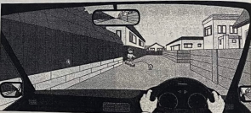
I think the child will notice my vehicle and stop, so I will pull to the right and pass.
I think the child has not noticed my vehicle because they are chasing the ball, so I will stop ahead.
I think the child will notice my vehicle and stop, but another child may run out from the alley on the right, so I will pull to the right and accelerate to pass.
Question 94. You are driving at 50 km/h. Wet fallen leaves are on the road after rain. What should you pay attention to when driving?
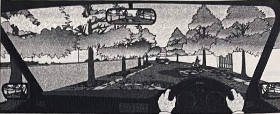
Oncoming vehicles may pull into the center of the road to avoid pedestrians, so I will pull to the left as much as possible when driving.
Wet fallen leaves can cause slipping, so I will reduce speed before the curve when driving.
Wet fallen leaves may affect vehicle control, so I will avoid them by moving to the left or right as much as possible in areas with many fallen leaves.
Question 95. You are driving at 40 km/h. What should you pay attention to when driving?
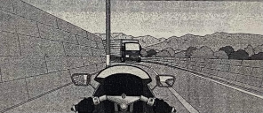
I think a two-wheeled vehicle may pass beside the pole due to its narrow width, so I will maintain speed, lean the vehicle, and pass through the curve.
Since there is a pole on the left, I will reduce speed before the pole when driving.
The road is narrow, and an oncoming vehicle is approaching, so I will reduce speed sufficiently before the curve and observe the situation when driving.