Honmen exam no 14
Question 1. When making a right or left turn (except at a roundabout), the signal should be given approximately 3 seconds before the action.
Question 2. When driving on roads with heavy fog or in a blizzard, it is necessary to turn on headlights to alert other traffic of your vehicle's presence and, if necessary, sound the horn to prevent danger.
Question 3. If you have held a regular motorcycle license for more than 3 years and are over 20 years old, you can carry a passenger on a large motorcycle on highways from the day you obtain a large motorcycle license.
Question 4. Before driving on highways, you must inspect your vehicle because repairs for breakdowns on highways are expensive.
Question 5. If a person who has not held a large motorcycle license for 1 year drives a large motorcycle, they can carry a passenger if they have held a regular motorcycle license for more than 1 year.
Question 6. At night, if you must park on a general road due to a breakdown, it is good to turn on a flashlight to protect the battery and make it clear to passing vehicles that you are parked.
Question 7. Even in a lane marked with a yellow line, you may change lanes if there are no following vehicles.
Question 8. A moped making a two-stage right turn does not need to signal for a right turn since it involves repeated straight movements.
Question 9. Under the Basic Act on Disaster Countermeasures, if a driver does not follow measures ordered by a police officer in a restricted area, the police officer may take those measures themselves.
Question 10. This sign indicates that vehicles other than two-wheeled vehicles cannot pass.

Question 11. Although overtaking was prohibited, I overtook because a slow-moving vehicle was ahead.
Question 12. Although the temperature was low and sprinkling water on the road in front of my house could cause it to freeze, I sprinkled water to prevent dust.
Question 13. If traffic ahead is congested and you would have to stop within an intersection, you must not enter the intersection even if the signal in your direction is green.
Question 14. Looking at the side or rearview mirrors while driving reduces attention to the front, so it is better to focus only on the road ahead.
Question 15. When driving at high speeds, vision may deteriorate, making nearby objects harder to see, so extra caution is required.
Question 16. This sign indicates a 'safety zone.'

Question 17. When approaching a pedestrian crossing and there are clearly no pedestrians crossing, you may proceed at the same speed without slowing down.
Question 18. Unless unavoidable, you must not cut in closely beside or in front of a vehicle driven by a novice driver or someone practicing with a learner's permit.
Question 19. When pushing a motorcycle with the engine off, you are treated as a pedestrian, but if you are towing another vehicle, you are not treated as a pedestrian.
Question 20. Parking is prohibited within 5 meters of firefighting equipment or fire prevention water tanks.
Question 21. If you have a small special vehicle license, you can drive a general moped.
Question 22. When overtaking a vehicle ahead, it is good to signal with the turn indicator and accelerate after about 3 seconds, and in this case, you may exceed the speed limit.
Question 23. When there are pedestrians crossing at or near an intersection without a crosswalk, you must slow down or stop temporarily to avoid obstructing their passage.
Question 24. Since balancing with the body is important for motorcycles, it is good to drive with the toes pointed outward and both knees as wide apart as possible.
Question 25. On a one-way road, high-speed vehicles should drive on the right side of the road.
Question 26. When parking an automatic vehicle, keep the brake pedal pressed, securely engage the handbrake, shift the gear lever to P, and then turn off the engine.
Question 27. When towing a broken-down vehicle with a rope, it is dangerous if the distance between the towing vehicle and the broken-down vehicle is not more than 10 meters.
Question 28. When the brakes fail while driving down a long slope, it is good to shift the gear to neutral.
Question 29. If a passenger checks the surroundings for safety when starting or reversing a vehicle, the driver is not responsible for any traffic accident that occurs.
Question 30. While driving, an earthquake warning was issued, so I drove slowly to prepare for the earthquake and listened to earthquake and traffic information on the car radio.
Question 31. Being able to fully push a motorcycle in a figure-eight pattern is one condition for choosing a motorcycle type.
Question 32. Vehicle owners must secure a storage place for their vehicle off the road and must not use the road as a storage place.
Question 33. The backrest of the driver's seat should be adjusted so that the elbows are slightly bent when both hands are on the steering wheel.
Question 34. At an intersection with poor visibility on both sides, if the traffic signal is green, you may proceed without slowing down.
Question 35. When following the vehicle ahead to cross a railway crossing, if you slow down and confirm safety, there is no need to stop temporarily to check safety.
Question 36. A car navigation system is useful for checking geography, but you must not stare at the screen while driving, so you must stop in a safe place to check it.
Question 37. When stopping at an intersection while driving an automatic vehicle with the gear lever in D (Drive), the vehicle may slowly move forward (creep phenomenon) if the brake pedal is not pressed, so you must firmly press the brake pedal and engage the handbrake.
Question 38. When visibility is poor due to fog or a blizzard, it is good to drive on the centerline.
Question 39. A road with a centerline or lane markings extending into the intersection is a priority road.
Question 40. With this signal, a route bus can proceed in the direction of the arrow.

Question 41. When driving on a highway, it is good to carry a stop indicator to signal a stop due to a breakdown.
Question 42. When a police officer at an intersection raises both arms horizontally by hand signal, vehicles facing the officer must turn right or left.
Question 43. Since motorcycles are highly maneuverable and can make tight turns, it is good to drive between vehicles during traffic congestion.
Question 44. The radiator and fan serve to prevent engine overheating.
Question 45. When driving an automatic vehicle and entering the main highway, it is good to shift the gear lever to L to accelerate.
Question 46. The validity period of a learner's permit is 6 months.
Question 47. When fatigued, sick, or worried, your attention may be distracted, or your judgment may be impaired, which can lead to unexpected accidents, so it is better to refrain from driving.
Question 48. When overtaking on a highway, since the driving speed is high, it is good to signal just before changing lanes.
Question 49. If you splash water or mud on a pedestrian while driving through mud or puddles, the driver is not responsible if driving slowly.
Question 50. On highways, in unavoidable cases such as breakdowns, you can stop or park on a sufficiently wide shoulder or roadside strip.
Question 51. When starting the vehicle, checking the rearview mirror alone may not clearly show the movement of vehicles behind, so it is important to check directly with your own eyes.
Question 52. When parking in a place with a parking ticket machine, you must immediately obtain a parking ticket and display it in a visible location at the front of the vehicle.
Question 53. When riding a motorcycle, wearing a construction safety helmet can substitute for a riding helmet.
Question 54. The difference between an automatic car and a manual car is the presence or absence of clutch operation, and there are no differences in driving methods.
Question 55. This sign designates the road section where the same vehicle can continue to park and indicates the duration for which parking is allowed.

Question 56. When riding a motorcycle through a curve, if you must brake immediately upon entering the curve, it is dangerous because the speed before entering the curve is too high.
Question 57. On a clear road where the left side is less than 6 meters wide, unless overtaking is prohibited by signs or markings or there is an oncoming vehicle, you may cross the centerline to the right side to overtake.
Question 58. When loading heavy cargo onto the bed of a cargo vehicle, placing it as far to the rear as possible makes steering lighter and safer.
Question 59. Even when entering a deceleration lane from the main highway, your sense of speed does not diminish, so it is better to drive based on your own speed perception rather than looking at the speedometer.
Question 60. Vehicles cannot travel within tram tracks, but they may cross them for right turns, left turns, crossing, or U-turns.
Question 61. On expressways or roads designated for vehicles with three or more lanes on one side, if a specific lane is designated for certain vehicles by road signs, you must use that lane.
Question 62. The purpose of requiring drivers aged 70 or older to display an 'elderly driver mark' is to inform others and protect them.
Question 63. Regular vehicles must not travel in a lane with this sign, except when making a left turn or in unavoidable cases such as roadwork.

Question 64. On general roads without speed limit signs or markings, you can overtake a vehicle traveling at 60 km/h.
Question 65. Overtaking is prohibited on pedestrian crossings and within 30 meters before them, but it is not prohibited on bicycle crossings or within 30 meters before them.
Question 66. On uphill slopes, you must drive in low gear regardless of the gradient.
Question 67. This sign indicates that there is a steep downhill slope ahead.

Question 68. To drive a car safely, there is no need to pay attention to clothing or footwear.
Question 69. If the traffic light turns green but the vehicle ahead does not start, you may sound the horn to urge it to move.
Question 70. On expressways, the maximum speed for regular cars with a displacement of 660cc or less and large motorcycles is the same.
Question 71. When loading cargo onto a regular moped, it may protrude up to 0.3 meters from the rear of the cargo device.
Question 72. For a motorcycle's engine brake, suddenly shifting from high to low gear can cause a fall, so shift down sequentially.
Question 73. In an automatic car, when going downhill, it is good to shift the gear lever to 2 or L (or 1) to utilize engine braking while driving.
Question 74. Where this marking is present, you must park at a right angle to the edge of the road.
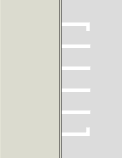
Question 75. Spike tires should not be used on roads other than snowy or icy roads, as they cause road surface damage and dust.
Question 76. When the side traffic light turns red, the front traffic light will soon turn green, so you may start when the side light turns red.
Question 77. If the water temperature gauge rises abnormally and does not drop (overheating) while driving, it is good to immediately turn off the engine switch and remove the radiator cap.
Question 78. When navigating a curve, centrifugal force may cause the vehicle to veer into the oncoming lane or roll over, so speed must be carefully controlled.
Question 79. Motorcycles may be overlooked by four-wheeled vehicle drivers, appear farther away, or seem slower, so extra caution is needed for right-turning four-wheeled vehicles at intersections.
Question 80. Children may assume that cars will stop for them, so you must not drive carelessly.
Question 81. When riding a motorcycle on rough roads like gravel or mud, grip the tank with your knees and, in some cases, ride in a standing posture.
Question 82. When passing near pedestrians, you must maintain sufficient distance or drive slowly, but this is not necessary when pedestrians are on the road shoulder.
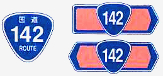
Question 83. This sign indicates a 'national highway number.'
Question 84. You cannot park or stop within the road shoulder marked by this sign.
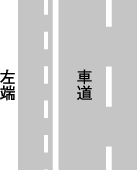
Question 85. Stopping for 10 minutes to load or unload cargo does not count as parking.
Question 86. When the rider of a motorcycle ahead bends their left elbow vertically, it has the same meaning as operating the right turn signal.
Question 87. Even if instructed to prevent illegal parking, repeated illegal parking with that vehicle will not result in restrictions on the vehicle's use.
Question 88. Fog or blizzards greatly reduce visibility, so turn on headlights, fog lights, and tail lights early, and sound the horn as needed.
Question 89. When crossing a road shoulder to enter or exit a place adjacent to the road, if there are pedestrians, pass slowly.
Question 90. When passing a parked vehicle and noticing someone inside, there is no obligation to stop temporarily, so I passed without taking precautions.
Question 91. You are driving at 50 km/h, and a motorcycle behind is attempting to overtake. What should you pay attention to while driving?
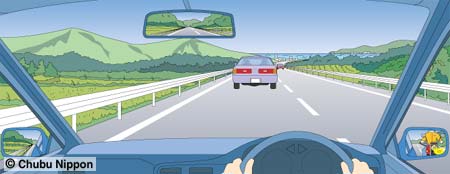
1. If an oncoming vehicle approaches, the motorcycle might cut in front of your vehicle, which is dangerous, so reduce the gap with the vehicle ahead to prevent this.
2. It is dangerous if the following motorcycle starts overtaking, so move toward the centerline to prevent it.
3. Motorcycles are highly maneuverable and will likely overtake easily, so continue driving as is.
Question 92. You are driving at 40 km/h. What should you pay attention to while driving?
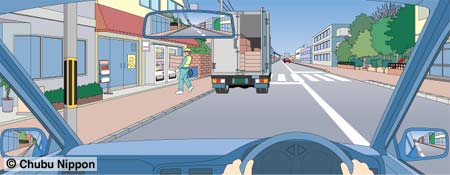
1. There may be pedestrians on the crosswalk beyond the truck, so stop temporarily before passing the side of a parked vehicle to move forward.
2. The truck's door may open suddenly, so approach at a speed where you can stop at any time with sufficient lateral distance, and stop temporarily before passing the side of a parked vehicle to move forward.
3. To pass the side of the truck before an oncoming vehicle arrives, accelerate and drive.
Question 93. You are driving at 40 km/h on a road after rain. What should you pay attention to while driving?
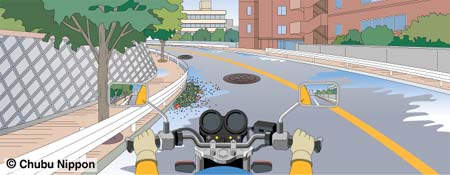
1. Manhole covers are slippery, so drive into the oncoming lane to avoid them.
2. Manhole covers are slippery, so slow down and pass without stepping on them.
3. Debris or sand at the road's edge is slippery, so avoid driving too close to the left side.
Question 94. You are driving at 15 km/h and turning left at an intersection following the vehicle ahead. What should you pay attention to while driving?
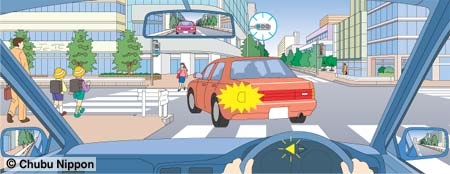
1. The vehicle ahead may stop suddenly to let pedestrians cross, so do not close the following distance.
2. To avoid hindering following vehicles, approach the vehicle ahead closely and turn left.
3. Sudden stopping following the vehicle ahead may cause a rear-end collision, so apply the brakes in stages to signal caution.
Question 95. You are driving at 30 km/h. What should you pay attention to while driving?
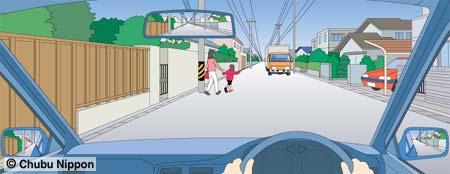
1. If you hurry, you can pass the pedestrian's side before an oncoming vehicle approaches, so accelerate and drive.
2. A child may step in front of your vehicle, so sound the horn while passing.
3. It is better to pass the pedestrian's side after passing an oncoming vehicle, so slow down, pull to the left, and stop.