Honmen exam no 13
Question 1. When the water temperature gauge rises abnormally and does not drop (overheating) while driving, it is best to immediately turn off the engine switch and remove the radiator cap.
Question 2. Highways have better road conditions compared to general roads, so you experience less fatigue during long drives and do not need to take breaks unnecessarily.
Question 3. If the traffic light at an intersection is green, you may proceed even if it is clear that you will have to stop within the intersection.
Question 4. In a time-limited parking zone with a parking ticket machine, you may park for the time indicated by the sign after obtaining a parking ticket.
Question 5. This sign indicates that there is a pedestrian crossing ahead.

Question 6. When starting a parked vehicle, since it is not a right turn or lane change, there is no need to perform safety checks or signal.
Question 7. While driving an ordinary passenger car on a road with a designated bus lane, I used the bus lane to make a left turn.
Question 8. During nighttime driving, switching to low beams reduces forward visibility and is dangerous, so it is better not to use low beams even when passing oncoming vehicles.
Question 9. Slowing down before a curve is necessary because turning at high speed, steering at high speed, or braking during a curve can cause the vehicle to roll over or skid sideways.
Question 10. If the load cannot be divided and the weight, size, or loading method exceeds regulations, you should report to the police chief at the destination.
Question 11. Parking is prohibited within 5 meters of the edge of a road construction zone.
Question 12. The area near the entrance or exit of a tunnel is a slow-driving zone.
Question 13. When braking on a motorcycle, use the engine brake while applying both the front and rear brakes simultaneously.
Question 14. The correct riding posture for a motorcycle is to lower the wrists, lightly grip the handlebars as if pushing them forward, keep the elbows slightly bent to act as springs, straighten the back, and direct the gaze forward.
Question 15. When riding a motorcycle on the left side of congested traffic, be cautious as bicycles may emerge from between cars or a car door may suddenly open, which is dangerous.
Question 16. Checking engine oil involves verifying that the oil level is within the range indicated by the oil level gauge.
Question 17. Even in areas where parking or stopping is prohibited by signs or markings, motorcycles, unlike four-wheeled vehicles, do not obstruct traffic, so they may park or stop.
Question 18. A person who has held an ordinary motorcycle license for over 3 years can carry a passenger on a highway even if under 20 years old.
Question 19. Within 10 meters before or after a railway crossing, parking or stopping is prohibited except when unavoidable to prevent danger.
Question 20. When driving for a long time, it is best to take a break every 2 hours.
Question 21. When feeling sleepy on a highway, it is best to park on the shoulder to rest.
Question 22. In a traffic accident, criminal liability lies with the driver, but civil liability is entirely borne by the insurance company of the vehicle.
Question 23. This sign indicates a designated lane for specific vehicles.

Question 24. When there is a 'Left Turn Permitted' sign at the left edge of the road or traffic light, left-turning vehicles have priority over crossing pedestrians.
Question 25. When a warning of a major earthquake was issued, I took my entire family in the car to evacuate via the highway.
Question 26. If you receive an impact to any part of your body in a traffic accident, even without visible injuries, it is best to seek a doctor's diagnosis to avoid potential aftereffects.
Question 27. On roads with low traffic, you can practice driving a car without a provisional license as long as a licensed driver is present.
Question 28. When riding a motorcycle through mud, avoid turning the handlebars too much, maintain a steady speed with the throttle, and balance while riding.
Question 29. Each prefecture's Traffic Safety Promotion Center responds to inquiries and consultations about parking and traffic regulations, so it is good to consult them when needed.
Question 30. On snowy or icy roads, in addition to installing studless tires or tire chains, reduce speed and maintain sufficient distance from other vehicles.
Question 31. When parking on a general road at night, you must turn on hazard lights, parking lights, or tail lights to avoid collisions.
Question 32. A vehicle with unmaintained steering, brakes, muffler, or other components must not be driven, as it may cause traffic hazards, emit toxic gases or noise, and disturb others.
Question 33. At a tram stop without a safety zone, a tram was stopped, but with no passengers boarding or alighting and a clearance of over 1.5 meters from the tram, I passed slowly.
Question 34. When a driver is tired, it takes longer to recognize and judge dangers, delaying braking and increasing stopping distance.
Question 35. When riding a motorcycle, maintain the correct riding posture to avoid leaning forward when braking.
Question 36. Drivers of cars or mopeds should join voluntary insurance to be prepared for unexpected situations.
Question 37. During highway driving, tires heat up and expand due to high-speed rotation, increasing air pressure, so it is best to set the pressure slightly below the specified level during inspection.
Question 38. If cargo falls or scatters on a highway, requesting removal via the emergency phone incurs costs, so the driver should handle it alone.
Question 39. The maximum speed on highways may be specified by signs depending on weather conditions or other factors.
Question 40. Stopping for passengers to board or alight or for loading/unloading cargo within 5 minutes does not count as parking.
Question 41. You must not park where there is less than 3.5 meters of space on the right side of the vehicle, but parking is allowed to assist an injured or sick person.
Question 42. When a general moped breaks down and is pushed without the engine running, it should travel on the right edge of the roadway.
Question 43. When a pedestrian is crossing where there is no nearby crosswalk, prioritize the pedestrian.
Question 44. Drivers must slow down or take other measures to avoid causing inconvenience to others when passing through muddy or waterlogged areas.
Question 45. When changing lanes while traveling in the same direction, the signal should be given approximately 30 meters before the lane change.
Question 46. This sign indicates that there is a slippery road surface ahead, so caution is required.

Question 47. When parking an automatic car on a downhill slope, it is better to put the gear lever in the 'R' position rather than the 'P' position.
Question 48. On a narrow slope where vehicles cannot pass each other, starting uphill is difficult, so the downhill vehicle yields the way.
Question 49. When changing lanes on a road with low traffic, signaling is sufficient, and there is no need for safety checks.
Question 50. As tires wear down, the contact area with the road increases, so the braking distance becomes shorter.
Question 51. When changing lanes, even if you are confident in your driving, it is important to accurately assess the surrounding traffic conditions and act accordingly.
Question 52. Driving with your elbow resting on the window frame not only worsens your driving posture but also delays actions to avoid danger in emergencies, which can lead to accidents, so it is better to avoid it.
Question 53. When turning a curve on a motorcycle, it is better to lean the body naturally to make the turn rather than steering the handlebars.
Question 54. At night, in places where parking and stopping are not prohibited, you can park for up to 8 hours.
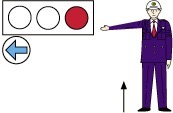
Question 55. The traffic light signal and the police officer's hand signal have the same meaning for traffic in the direction of the arrow.
Question 56. During heavy snow, the road's center line may become invisible, making it difficult to confirm your vehicle's position, so it is better to drive slowly while observing objects like utility poles or snow poles.
Question 57. This sign indicates a no-entry zone for vehicles, meaning cars, mopeds, and bicycles cannot enter.

Question 58. Automatic motorcycles always transmit engine power to the wheels, so they do not lose stability even when the throttle is released.
Question 59. Motorcycles are often overlooked by four-wheeled vehicle drivers, appear farther away than they are, or seem slower, so extra caution is needed for right-turning four-wheeled vehicles at intersections (except roundabouts).
Question 60. When overtaking, signal with the right turn indicator, wait about 3 seconds, then accelerate within the speed limit while gradually changing lanes, passing the vehicle ahead on the right with a safe distance.
Question 61. When a child is walking alone, the driver must stop temporarily or drive slowly to ensure the child can pass safely.
Question 62. You must not overtake a vehicle ahead if there is a risk of interfering with the progress of oncoming vehicles from the opposite direction.
Question 63. When about to collide with an oncoming vehicle, do not give up until the last moment and steer or brake to swerve to the left as much as possible.
Question 64. A taxi driver, even when driving in a lane designated for left turns at an intersection by signs or markings, can proceed straight through the intersection to pick up a passenger signaling ahead.
Question 65. Compared to manual cars, automatic cars shift gears automatically, so the engine braking effect is greater.
Question 66. You must not overtake a regular car displaying a beginner's mark.
Question 67. Although the road's center line was a solid yellow line, I crossed it to overtake.
Question 68. While driving at night, the headlights of your vehicle and oncoming vehicles may obscure pedestrians near the road's center, so caution is needed.
Question 69. When driving a car and entering a tunnel, if the headlights are already on, there is no need to slow down.
Question 70. When pedestrians or bicycles are crossing a pedestrian crossing or bicycle crossing, you must slow down before reaching it.
Question 71. When reversing, your driving posture may change to check the rear, so in an automatic car, you must confirm the position of the accelerator and brake pedals before operating carefully.
Question 72. A cargo vehicle with a gross vehicle weight of less than 3,500 kilograms and a maximum load capacity of less than 2,000 kilograms can be driven with a regular driver's license.
Question 73. This sign indicates that you must not drive at a speed exceeding 50 kilometers per hour.

Question 74. On highways, vehicles in the driving lane should use the white line on the right as a guide and drive on the right side of the lane.
Question 75. While driving on the highway in strong crosswinds, I closely followed a large cargo vehicle ahead.
Question 76. Since a towed broken-down vehicle has no automotive functions, even someone without a driver's license can operate the steering or brakes.
Question 77. On rainy days, visibility is poor, so to avoid head-on collisions with oncoming vehicles, it is better to drive as close to the shoulder as possible.
Question 78. If the traffic light ahead turns yellow, even if you can safely stop at the stop line before the intersection, you may proceed if traffic is light.
Question 79. Road shoulders without pedestrians may be used for passage by regular mopeds only.
Question 80. A regular moped making a two-stage right turn does not need to signal a right turn, as it may confuse surrounding drivers.
Question 81. To enter a gas station adjacent to the road, you may cross sidewalks or bicycle paths if unavoidable.
Question 82. Using a mobile phone or staring at the display of a car navigation system while driving reduces attention to surrounding traffic conditions, which is dangerous.
Question 83. This sign indicates a prohibition on U-turns.

Question 84. When placing a young child in a car, a child seat appropriate for the child's developmental stage must be used.
Question 85. Since I did not have a driver's license, I let a friend who I knew had been drinking drive me home.
Question 86. It is good to attach an elderly driver mark to the back of the car.
Question 87. When driving a regular motorcycle, if one year has passed since obtaining a regular motorcycle license, you can carry a passenger even without a passenger seat.
Question 88. When the engine is running, if the exhaust gas is colorless or light blue, it indicates good engine combustion.
Question 89. When passing through a railway crossing following the vehicle ahead, you do not need to stop temporarily if you slow down and confirm safety.
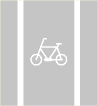
Question 90. This marking indicates a bicycle crossing.
Question 91. You are driving on the highway at 70 km/h and approaching an entry ramp. What should you pay attention to while driving?
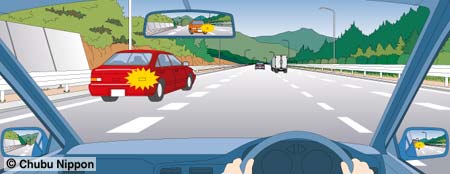
1. To make it easier for vehicles in the acceleration lane to merge, accelerate to create space behind your vehicle.
2. To make it easier for vehicles in the acceleration lane to merge, maintain a constant speed while driving.
3. To make it easier for vehicles in the acceleration lane to merge, change to the overtaking lane before following vehicles.
Question 92. You are driving at 25 km/h. What should you pay attention to while driving?
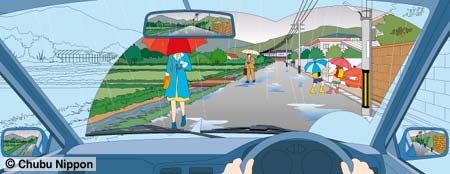
1. Pedestrians may not notice your vehicle's approach, so slow down and pay attention to their movements.
2. To avoid splashing water or mud on pedestrians, slow down while passing.
3. Children on the right may be playing and could dart in front of your vehicle, so pass at a speed where you can stop at any time.
Question 93. You are driving at 40 km/h and going straight through an intersection. What should you pay attention to while driving?
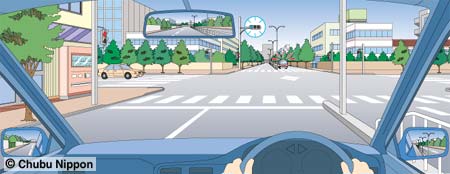
1. Even if an emergency vehicle in the oncoming lane turns right, your vehicle has priority going straight, so continue driving as is.
2. The emergency vehicle in the oncoming lane is not signaling a right turn, so continue driving as is.
3. Since it is unclear what the emergency vehicle in the oncoming lane might do, do not enter the intersection and pull over to the left to stop.
Question 94. You are driving at 30 km/h and going straight through an intersection. What should you pay attention to while driving?
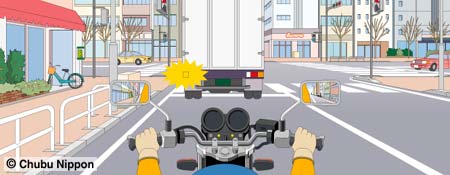
1. Since trucks take time to turn left, proceed by crossing into the oncoming lane.
2. The truck might stop suddenly, so slow down and keep a safe following distance.
3. Your vehicle may be obscured by the truck and overlooked by an oncoming right-turning vehicle, so proceed with caution.
Question 95. You are stopped just before a railway crossing. What should you pay attention to when passing through the crossing?
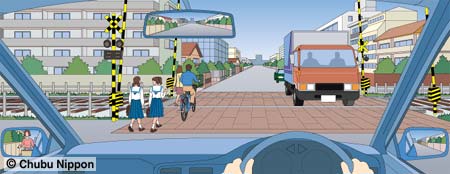
1. Pedestrians or bicycles may emerge from the right, so pay attention to their movements.
2. There is a bicycle to the left rear, so pay attention to its movements to avoid contact.
3. Passing a truck alongside pedestrians or bicycles is dangerous, so start after the truck has passed.