Honmen exam no 12
Question 1. Even if you cause a traffic accident, you do not need to report it to the police if you reach an agreement with the other party.
Question 2. At an intersection where traffic is controlled by a traffic light, if the light is red but a police officer signals 'proceed' with a hand signal, you should follow the police officer's hand signal.
Question 3. This sign prohibits pedestrians from crossing the street.

Question 4. At a location with this sign, you may cross the road if your garage is on the right side of the road.

Question 5. When parking an automatic vehicle, even for a short time, it is best to put the gear lever in the 'P' position and securely apply the handbrake.
Question 6. This sign indicates that there is a time-limited parking zone with a parking ticket machine in the direction of the arrow.

Question 7. When the traffic signal in the direction of travel is flashing yellow, pedestrians, remotely controlled small vehicles, cars, or trams may proceed while paying attention to other traffic.
Question 8. When stopping behind another vehicle on an uphill slope, it is best to reduce the distance between vehicles.
Question 9. When passing through a deep puddle, water may enter the brake drum, causing the brakes to fail, so you should check if the brakes are working after passing through.
Question 10. When braking, it is best to press the brake pedal as hard as possible initially.
Question 11. When changing lanes, if there is not enough distance from a vehicle approaching from behind, it is better to change lanes quickly.
Question 12. A person who has held a motorcycle license for 3 years can carry a passenger on a highway.
Question 13. Hanging mascots or similar items on the windshield or rearview mirror can obstruct the view and potentially interfere with driving, hindering safe operation.
Question 14. Sudden starts, rapid acceleration, and revving the engine not only increase exhaust emissions but also cause noise and other traffic pollution, disturbing local residents.
Question 15. When the friction between tires and the road is low, steering becomes easier, so you should increase speed on wet roads.
Question 16. When the vehicle in front signals to change lanes for a right or left turn, you must not obstruct its path, but you do not need to yield if avoiding it requires sudden steering or braking.
Question 17. An uncontrolled intersection is one where traffic is not regulated by traffic signals, police officers, or traffic wardens' hand signals (including light signals).
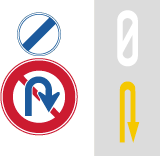
Question 18. This sign and marking both indicate the end of a no-U-turn zone.
Question 19. Mopeds and small special vehicles may travel in bus-only lanes, but large motorcycles and similar vehicles may not, except when turning left or in unavoidable circumstances.
Question 20. When turn signals are hard to see due to reflections from the setting sun, it is good to use hand signals in addition to operating the turn indicators.
Question 21. It is acceptable to offer a small amount of alcohol to someone who is about to drive a car.
Question 22. Rearview and side mirrors are installed to compensate for a vehicle's blind spots.
Question 23. In areas where parking is not prohibited, you may not park continuously for more than 12 hours (or 8 hours at night), except on roads in certain village areas.
Question 24. Understanding the natural forces acting during driving, such as friction and centrifugal force, can help prevent traffic accidents.
Question 25. When attempting to overtake, you must first confirm that the location is not a no-overtaking zone.
Question 26. After installing a child seat, if it wobbles when shaken, it is fine as long as it is installed.
Question 27. The luggage rack of a general moped must not carry loads exceeding 30 kilograms.
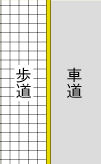
Question 28. This sign prohibits pedestrian passage for safety reasons, so vehicles can pass.

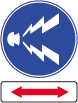
Question 29. In areas with this sign, you must sound the horn at intersections, curves, or hilltops with poor visibility.
Question 30. Immediately after a train passes a railway crossing, another train may approach from the opposite direction, so great caution is required.
Question 31. Parking refers to a vehicle being continuously stopped or stopped in a state where the driver is away from the vehicle and cannot drive immediately.
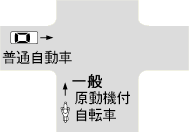
Question 32. At an uncontrolled intersection like the one shown, a general moped must not obstruct the progress of an ordinary car approaching from the left.
Question 33. At night, when driving in a busy urban area, you should switch to high beams even in well-lit areas with streetlights.
Question 34. Within 5 meters of a construction site, parking is prohibited, but stopping is not prohibited.
Question 35. The license plate on the rear of a motorcycle only needs to be partially visible from behind, so it is okay to bend it while driving.
Question 36. When exiting a highway's main road, you must travel in the lane connected to the exit (or the deceleration lane if present) and reduce speed while checking the speedometer, not relying on instinct.
Question 37. In a place where parking is not prohibited, I parked the car, judging that there was 2.5 meters of space on the right side and little traffic, so it would not obstruct traffic.
Question 38. Motorcyclists should anticipate being overlooked by four-wheeled vehicle drivers, especially at intersections, by sitting upright to be more visible and paying close attention to oncoming traffic.
Question 39. When starting an automatic vehicle's engine, ensure the handbrake is engaged and the gear lever is in the 'P' position, then press the brake pedal before starting the engine.
Question 40. On snowy roads, stopping distances are longer, so it is best to drive at a consistently reduced speed.
Question 41. A person with a provisional driver's license can practice driving alone as long as the provisional practice sign is attached to the designated position on the vehicle.
Question 42. When driving a car, maintain a relaxed and correct posture, adjust the rearview mirror to ensure rear safety checks, and then start driving.
Question 43. At night, when passing an oncoming vehicle, headlights from both vehicles may obscure pedestrians near the center of the road, so you must drive with great caution.
Question 44. When changing lanes to the left while traveling in the same direction, the signal should be given 1 second before the action.
Question 45. When braking while riding a motorcycle, it is important to apply the brakes in several stages.
Question 46. This sign indicates that there is an uphill slope ahead and that caution is needed for oncoming traffic.

Question 47. When driving a car with worries that may distract you, it is best to reduce speed and drive.
Question 48. When parking on a road without a sidewalk or shoulder, you must leave at least 0.75 meters of space on the left side of the vehicle.
Question 49. On a slope, the principle is that uphill vehicles yield to downhill vehicles.
Question 50. The hand signals for turning right and stopping are exactly the same.
Question 51. When the engine overheats while driving, it is good to keep the engine running, open the hood, and pour water on the engine to cool it down.
Question 52. The legal maximum speed for large motorcycles on expressways is 100 kilometers per hour.
Question 53. This sign indicates a road exclusively for regular bicycles and pedestrians.

Question 54. Parking and stopping are prohibited within 10 meters before and after a railway crossing.
Question 55. To overtake safely, it is important to assess the speed of the vehicle ahead and road conditions, and accurately judge the distance and speed required for overtaking.
Question 56. The correct riding posture for a motorcycle is to place the arches of your feet on the steps, keep the soles of your feet parallel to the ground, point your toes straight forward, and grip the tank with both knees.
Question 57. Due to road construction, the left side of the road was not sufficient for passage, so I drove over the center to the right side.
Question 58. When driving at night and passing by brightly lit places such as 24-hour stores or gas stations, your vision may temporarily decrease, making it easy to overlook parked vehicles or pedestrians in less lit areas, so caution is needed.
Question 59. When a regular moped intends to make a two-stage right turn at an intersection, it must keep to the left edge of the road.
Question 60. Since motorcycles are easily overlooked by four-wheeled vehicle drivers, it is good to wear bright-colored clothing or helmets to be more noticeable to other drivers.
Question 61. Vehicles structurally incapable of exceeding 50 kilometers per hour cannot travel on expressways.
Question 62. When there is an obstacle ahead in your path, stop or slow down in advance to let vehicles coming from the opposite direction pass first.
Question 63. When passing near a safety zone, you must drive slowly regardless of whether there are pedestrians in the safety zone.
Question 64. If you perform daily maintenance checks, there is no need to conduct additional checks just because you are driving on an expressway.
Question 65. When a motorcycle applies sudden brakes, the wheels may lock (stop turning), which can cause skidding.
Question 66. When the engine RPM rises and does not drop, it is good to continue driving with a half-clutch.
Question 67. When riding a motorcycle on muddy roads, it is good to make large steering adjustments to maintain balance.
Question 68. On roads designated for bicycles and pedestrians, vehicles can pass only when there are no bicycles or pedestrians present.
Question 69. This marking indicates that stopping is allowed but parking is prohibited.
Question 70. When making a right turn at an intersection (except at a roundabout), you must drive slowly along the inner side of the intersection's center.
Question 71. While driving on the highway, an emergency vehicle was trying to merge onto the main road from the acceleration lane, but since vehicles on the main road have priority, I passed without slowing down.
Question 72. The riding position on a motorcycle should be with both elbows extended outward and sitting as far forward as possible.
Question 73. When there is a vehicle stopped before a pedestrian crossing or bicycle crossing, you must stop temporarily before passing it and moving forward.
Question 74. When you must drive significantly slower than other vehicles, you should keep to the left side of the road to avoid disrupting traffic flow.
Question 75. When parking on a highway due to running out of fuel or a breakdown, you must place a stopping indicator behind the vehicle.
Question 76. With a regular driver's license, you can drive regular cars, small special vehicles, and mopeds under 50cc, but not regular motorcycles.
Question 77. Snowy downhill roads are slippery, so use engine braking and lightly tap the foot brake in small increments.
Question 78. When passing near where children are playing, you must be cautious enough to stop immediately if they suddenly run out.
Question 79. Inside a tunnel, parking or stopping is prohibited except for temporary stops to prevent danger.
Question 80. A cargo vehicle with a maximum load capacity of 2,000 kilograms can be driven with a regular driver's license.
Question 81. If one foot's toes slightly touch the ground and can support the motorcycle when straddling it, it is considered a suitable model for your physique.
Question 82. When towing a broken-down vehicle with a rope, a rope longer than 5 meters must be used, with a yellow cloth of at least 0.3 square meters attached to its center.
Question 83. At the exits of tunnels or cuttings on highways, crosswinds may affect the steering, so you must pass with caution.
Question 84. Automatic motorcycles do not require clutch operation, which reduces the operational burden, but you still need to understand the basics and drive safely.
Question 85. While driving a regular car and approaching a bicycle crossing, since bicycles were crossing, I drove slowly and passed directly in front of them.
Question 86. Since an acquaintance was affected by an earthquake, I loaded emergency supplies like water into a regular car and immediately headed to the disaster area.
Question 87. When driving an automatic car on a long or steep downhill, it is good to keep the shift lever in the 'D' position and control speed with the foot brake.
Question 88. If tire pressure is not equal on both sides, it can cause uneven tire wear.
Question 89. Vehicle rollovers or veering into oncoming lanes at curves are caused by steering or brake operation errors, not by excessive speed or overloading.
Question 90. The user of a vehicle marked with an abandoned vehicle confirmation tag may be ordered by the Public Safety Commission to pay a fine for illegal parking.
Question 91. You are driving at 40 km/h. What should you pay attention to while driving?
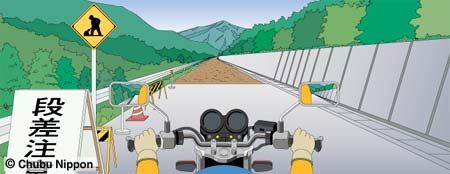
1. Gravel roads are more slippery than asphalt and can make the vehicle unstable, so slow down before entering.
2. Gravel roads are prone to slipping, so avoid sudden acceleration or sharp steering.
3. The handlebars may be affected at the boundary between asphalt and gravel, so grip the handlebars firmly and accelerate to pass through.
Question 92. You are driving at 40 km/h, and the traffic light turns yellow. What should you pay attention to while driving?
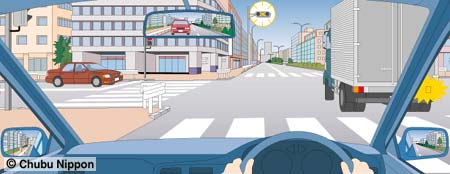
1. Sudden stopping is dangerous, so continue driving, but since an oncoming right-turning vehicle may emerge from behind a truck, sound the horn while passing through the intersection.
2. Sudden stopping may cause a rear-end collision, so accelerate to pass through the intersection quickly.
3. Since the traffic light turned yellow, immediately apply the brake and stop abruptly.
Question 93. You are driving on the highway at 80 km/h. What should you pay attention to while driving?
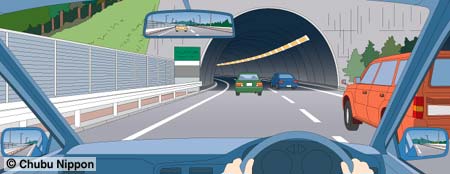
1. Inside tunnels, the sense of speed or distance may change, so slow down and drive cautiously.
2. Due to the oppressive feeling in tunnels, the vehicle in front to the right may veer toward your vehicle, so slow down and keep a safe distance.
3. Since tunnels are dim, follow the taillights of the vehicle ahead by reducing the following distance.
Question 94. You are driving at 40 km/h, and the oncoming lane is congested. What should you pay attention to while driving?
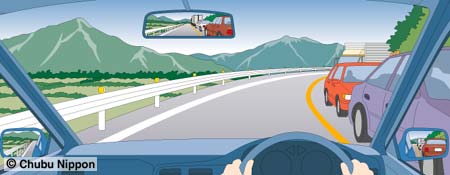
1. A motorcycle may come from beyond the curve, crossing the center line, so slow down and drive on the left side.
2. Visibility ahead is poor, and there may be congestion beyond the curve, so slow down while driving.
3. Since your lane is clear, continue driving at the same speed.
Question 95. You are driving at 20 km/h. What should you pay attention to while driving?
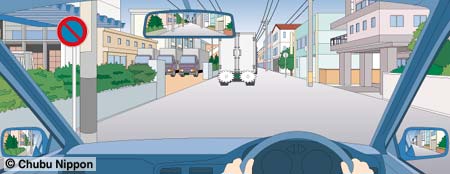
1. The truck ahead is likely to reverse into the left entrance, so pass by moving to the right side.
2. The truck ahead may reverse without noticing your vehicle, so stop in place and check the rear for safety to be ready to reverse if needed.
3. The truck ahead is likely to notice your vehicle and stop reversing, so pass by moving to the right side.