Honmen exam no 11
Question 1. Vehicles or trams facing this signal must not proceed beyond the stop line.

Question 2. When the user of a vehicle marked with an abandoned vehicle sticker drives it, they may remove the sticker to prevent traffic accidents.
Question 3. On roads with a climbing lane, slow vehicles such as trucks carrying heavy loads must use the climbing lane and yield to faster vehicles.
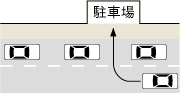
Question 4. When trying to pass through stopped oncoming vehicles due to traffic congestion to enter a parking lot on the right side of the road, anticipate that general mopeds or similar vehicles may pass on the left side of oncoming vehicles, so stop temporarily and proceed with caution.
Question 5. When starting a vehicle, even if a motorcycle is approaching from behind, a four-wheeled vehicle has priority and can start.
Question 6. If the road in front of your home is not a no-parking zone, you can park there for more than 8 hours at night as long as it does not obstruct other traffic.
Question 7. The correct riding posture for a motorcycle is to put strength in the shoulders and extend the elbows.
Question 8. When stopping at an intersection or other location while driving an automatic vehicle, shift the gear lever to N and engage the handbrake.
Question 9. Due to a river flood, a police officer prohibited crossing a bridge, but since it was not indicated by a sign, I ignored it and crossed the bridge.
Question 10. During a major earthquake, I thought it was dangerous with people running to evacuate, so I drove while sounding the horn.
Question 11. When the friction between tires and the road is low, steering becomes easier, so on wet roads, it is fine to brake later.
Question 12. On a road without a speed limit sign, it is permissible to temporarily exceed 60 km/h to overtake a passenger car traveling at that speed.
Question 13. Except where signs prohibit crossing to the right for overtaking, on a clear road with a left-side width of less than 6 meters, you may cross the center to the right side to overtake.
Question 14. At night, when following another vehicle, it is best to pay attention to its brake lights while driving.
Question 15. At night in busy urban areas, always switch the headlights to high beam while driving.
Question 16. On a motorcycle, sudden braking can lock the wheels, which is dangerous, so safe braking practices must be followed.
Question 17. Waiting for a passenger for 10 minutes in a no-parking zone does not count as parking.
Question 18. When riding a motorcycle, it is best to choose a model that suits your physique and strength.
Question 19. When overtaking, check the safety ahead as well as the right and right-rear sides using the rearview mirror.
Question 20. When parking an automatic vehicle, even for a short time, the gear lever must be shifted to P, but there is no need to engage the handbrake if it is in P.
Question 21. On a highway, when surrounding vehicles are exceeding the maximum speed, it is best for safety to match their speed and exceed the maximum speed.
Question 22. On wet asphalt or snowy roads, the road is slippery, and the friction between tires and the road increases, so the braking distance becomes shorter.
Question 23. When braking on a general moped, it is best to avoid using the front brake as much as possible and use only the rear brake.
Question 24. Pressing the brake pedal in several short bursts causes the brake lights to flash, serving as a signal to following vehicles and helping prevent rear-end collisions.
Question 25. When reversing a vehicle, it is not necessary to wear a seatbelt.
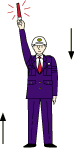
Question 26. A police officer’s light signal as shown in the figure has the same meaning as a yellow traffic signal for the direction of traffic indicated by the arrow.
Question 27. When a vehicle turns right from a one-way road (except at roundabouts), it must keep as close as possible to the center of the road and pass through the inner side of the intersection.
Question 28. The centrifugal force acting on a vehicle during a curve is proportional to the square of the speed, so if the speed doubles, the centrifugal force quadruples.
Question 29. This sign is a 'no parking' sign.

Question 30. Do not use motorcycle helmets that cannot be securely fixed to the head or that cannot have their chin straps properly fastened.
Question 31. The only type of vehicle that can be driven with a provisional license is a passenger car.
Question 32. Vehicle lights such as headlights, tail lights, and brake lights have no specific regulations regarding color or brightness, so any color or brightness is acceptable.
Question 33. Since some pedestrians, such as the elderly or children, may act unpredictably, it is better to speed up and pass them quickly rather than slowing down.
Question 34. This sign indicates that the road ahead is a Y-shaped intersection.

Question 35. You must not cut in or crowd a passenger car with a provisional license sign, but it is permissible to do so with a beginner driver sign.
Question 36. Even at the top of an uphill slope with poor visibility, there is no need to slow down, as it is unlikely that oncoming vehicles will cross the center line.
Question 37. Removing the muffler core of a motorcycle increases noise, disturbing others, causing traffic pollution, and making the vehicle subject to penalties for poor maintenance.
Question 38. With a provisional license, you cannot drive for purposes other than practice, road tests, or final examinations.
Question 39. At night, when unavoidably parking on a highway, placing a warning triangle is sufficient, and there is no need to turn on hazard lights or other lights.
Question 40. Large, medium, and quasi-medium vehicles have higher driver seats, giving a downward view, which can make the following distance feel longer than it is, leading to shorter actual distances, so caution is needed.
Question 41. With a moped license, you cannot drive a two-wheeled vehicle with an engine displacement exceeding 50cc (or 125cc for those with a maximum output of 4.0kW or less).
Question 42. The guideline for following distance on a highway is 50 meters when traveling at 100 km/h.
Question 43. This marking indicates a location where one vehicle must park within the area marked by white lines, along the edge of the road.

Question 44. Within the designated speed range, it is permissible to repeatedly start or accelerate suddenly.
Question 45. When passing a bicycle to turn left at an intersection, I almost collided with it, so I sounded the horn to alert the cyclist and turned left first.
Question 46. When changing lanes at night or in rainy conditions with poor visibility, it is especially necessary to thoroughly check for other vehicles on the sides and behind.
Question 47. This sign indicates that vehicles can go straight or turn right but cannot turn left.

Question 48. On snowy roads, if there are tracks from other vehicles, driving along them is safe even at high speeds.
Question 49. Kickdown in an automatic vehicle refers to the operation where pressing the accelerator pedal firmly causes the gear to shift down automatically, enabling rapid acceleration.
Question 50. For vehicle passenger capacity, children under 12 years old are calculated as three children equaling two adults.
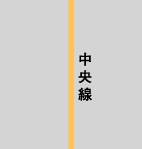
Question 51. This marking indicates that you cannot veer into the right side of the road to overtake.
Question 52. While driving on an unfamiliar road, I finally found the target road, but suddenly signaling and turning would be dangerous and disrupt surrounding traffic, so I continued straight.
Question 53. Thinking it would obstruct other vehicles' passage, I parked with the left wheels on the sidewalk.
Question 54. When riding a motorcycle through a corner or curve, it’s best to avoid disengaging the clutch and adjust speed with the throttle while turning.
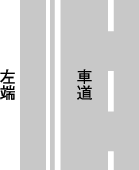
Question 55. The roadside strip marked by two white solid lines allows vehicles to enter and park or stop.
Question 56. On a road where one side is a cliff with a risk of falling, if safe passing is not possible, the vehicle on the mountain side must stop temporarily and yield the way.
Question 57. When a vehicle moves to the right side of the road to overtake, it must take sufficient care regarding the movements of the vehicle ahead, oncoming vehicles, and pedestrians crossing ahead.
Question 58. On a road with a designated priority lane for route buses, vehicles must promptly exit the lane and yield to route buses when they approach.

Question 59. When it starts raining while driving, an oil film on the windshield can reduce visibility, so it’s good to clean it with washer fluid.
Question 60. A truck was stopped in front of an uncontrolled crosswalk, but I passed by its side at the same speed.
Question 61. For the handbrake, it’s better to have more play when the lever is fully pulled.
Question 62. If the engine overheats while driving, immediately stop the vehicle, remove the radiator cap, and add water.
Question 63. When starting a vehicle, check the surroundings for safety using the rearview and side mirrors, but blind spots that cannot be checked must be visually confirmed.
Question 64. This sign means that parking is allowed if the road width is 6 meters.
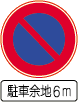
Question 65. In a traffic accident, if an injured person is unconscious and does not respond to loud calls or shoulder taps, lower their chin to constrict the airway as a first aid measure.
Question 66. When a motorcycle is following a four-wheeled vehicle, the vehicle ahead may change course without noticing the motorcycle, so caution is required.
Question 67. For a private ordinary passenger car with annual regular inspections, daily maintenance checks should be conducted at appropriate times based on mileage and operating conditions.
Question 68. When a pedestrian is crossing a crosswalk, vehicles must stop temporarily, but when a pedestrian is about to cross, vehicles can proceed slowly.
Question 69. While driving, to prevent drowsiness, open the window slightly for fresh air and take a break when feeling sleepy.
Question 70. Within 10 meters of a bus stop sign or pole, parking or stopping is prohibited during operating hours to avoid interfering with bus departures and arrivals.
Question 71. Since there are no pedestrians or cyclists on highways, there is no mental fatigue, and continuous driving for long periods is possible.
Question 72. At a location with these two signs, reversing is also prohibited at the same time.

Question 73. Passing through deep puddles can get water in the brake drum, reducing braking effectiveness, but since the brakes dry out with heat, there’s no need to avoid puddles.
Question 74. Continuing high-speed driving with low tire pressure can cause a wobbling effect and tire overheating, risking a blowout, so keep tire pressure slightly high.
Question 75. At night, there may be fatigued or drunk drivers or intoxicated pedestrians on the road, so drive more slowly and cautiously than during the day.
Question 76. When there are three or more lanes in the same direction, the rightmost lane must be kept clear for overtaking.
Question 77. At intersections with poor visibility, you must always sound the horn, even outside areas marked with a 'horn section' sign.
Question 78. Even after driving on a highway, speed perception doesn’t dull, so there’s no need to check the speedometer.
Question 79. If a motorcycle gets a flat tire while driving, it’s best to stop immediately, so apply the brakes sharply.
Question 80. In a traffic accident, first take measures to prevent secondary accidents, then provide first aid to the injured, and afterward report to the police.
Question 81. Illegal parking or stopping causes traffic congestion and reduces road visibility, leading to accidents involving pedestrians or others darting out.
Question 82. When driving down a long slope, it’s better to use the foot brake than the engine brake.
Question 83. When riding a motorcycle through mud or gravel, maintain a steady speed with the throttle and pass while keeping balance.
Question 84. The inner wheel difference refers to the difference in the paths of the front and rear wheels when a vehicle turns, with the rear wheels tracking inside the front wheels.
Question 85. At an intersection with this sign, a general motorized bicycle turning right does not need to signal a right turn while proceeding to the turning point.

Question 86. When passing near pedestrians, vehicles must maintain a safe distance from them or proceed slowly.
Question 87. When there’s an obstacle ahead, it’s best to speed up to pass the spot before an oncoming vehicle.
Question 88. For a light vehicle with a displacement of 660cc or less, it’s permissible to remove or relocate the license plate arbitrarily.
Question 89. Yielding at intersections causes traffic congestion or accidents, so it’s better to drive selfishly.
Question 90. Automatic motorcycles, which don’t require clutch operation, risk sudden acceleration if the throttle is turned sharply, so caution is needed.
Question 91. You are driving at 30 km/h. What should you pay attention to when turning left at an intersection?
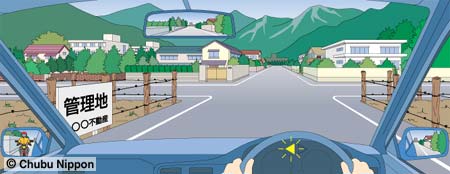
1. The motorcycle behind likely notices I’m turning left, so I turn left as is.
2. Turning left as is might involve the motorcycle behind, so I accelerate to turn left before it.
3. Turning left as is might involve the motorcycle behind, so I slow down and watch its movements.
Question 92. You are driving at 40 km/h. What should you pay attention to while driving?
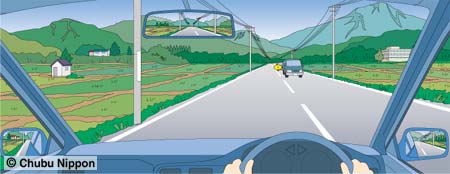
1. The oncoming car is attempting to overtake, and continuing as is might lead to a head-on collision, so I slow down and move as far left as possible.
2. The oncoming car’s overtaking is dangerous, so I sound the horn to warn and continue driving as is.
3. The oncoming car’s overtaking is dangerous, so I accelerate to prevent it from overtaking.
Question 93. You are driving at 40 km/h. What should you pay attention to while driving?
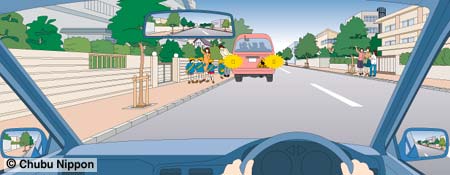
1. The kindergarten bus likely won’t start moving yet, so I veer into the oncoming lane and pass as is.
2. If an adult is present, children won’t dart out, so I pass at the same speed.
3. A child might cross in front of the kindergarten bus, so I sound the horn and pass.
Question 94. You are driving at 30 km/h in fog. What should you pay attention to while driving?
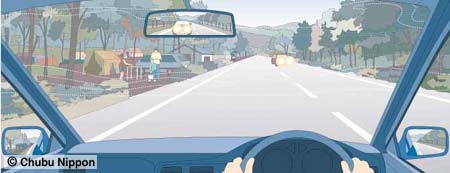
1. Fog reduces visibility, and someone might dart out, so I slow down and stay cautious.
2. With headlights on, pedestrians likely notice my vehicle and won’t dart out, so I continue as is.
3. Fog makes it hard to see surroundings, so I slow down and sound the horn as needed.
Question 95. You are driving at 50 km/h. What should you pay attention to while driving?
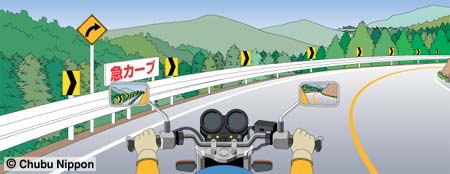
1. I might not make the curve and hit the guardrail, so I drive closer to the centerline.
2. The oncoming vehicle might cross the centerline, so I sound the horn to warn and continue at the same speed.
3. Visibility is poor, and the situation beyond the curve is unclear, so I slow down and drive on the left side.