Honmen exam no 10
Question 1. While waiting at a railway crossing with a traffic signal, I started moving when the signal turned green without checking the traffic conditions on the other side of the crossing.
Question 2. The number on the sticker attached to the windshield of an ordinary passenger car indicates the date of the next inspection.
Question 3. This sign indicates that you must be cautious because the steering may be pulled to the right.

Question 4. At night, if a vehicle breaks down on a highway, in addition to placing a warning triangle, you must turn on the hazard lights, tail lights, or parking lights.
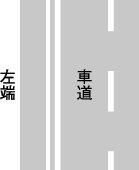
Question 5. This roadside strip allows passage for light vehicles, but parking or stopping within it is prohibited.
Question 6. To maintain stability on a motorcycle, it is best to sit in the center of the left-right balance.
Question 7. The traffic signal at the intersection was red, but I proceeded because a construction site guard signaled 'go' with a hand gesture.
Question 8. In a curve, the smaller the radius of the curve, the greater the centrifugal force.
Question 9. On snowy roads, the tracks left by the vehicle ahead may be icy and slippery, so it is best to avoid them and drive elsewhere.
Question 10. The driver must wear a helmet and ensure that any passenger also wears one.
Question 11. In the event of a major earthquake, when unavoidably leaving a vehicle on the road, you must stop the engine, open the windows, and remove the ignition key.
Question 12. Snowy or icy roads are slippery, and the braking distance becomes significantly longer, more than three times that of dry summer roads.
Question 13. When parking on a road without a roadside strip, you must leave 0.5 meters of space for pedestrians.
Question 14. Motorcycle riders should start with smaller models and move to larger ones as their skill level improves.
Question 15. When the traffic signal at an intersection turned yellow, I could have stopped safely, but since a yellow signal does not mean 'stop,' I proceeded with caution.
Question 16. When stopping an automatic car, firmly press the brake pedal and, for added safety, engage the handbrake.
Question 17. In a tunnel without traffic lanes, you must not change your path or pass beside a car or general moped to overtake.
Question 18. When approaching a curve on a motorcycle, disengage the clutch to maintain stability with momentum, and gradually accelerate in the latter half of the curve while checking the safety ahead.
Question 19. In the event of a traffic accident, to prevent secondary accidents, move the vehicle to the shoulder or an open space so as not to obstruct other traffic and stop the engine.
Question 20. While driving a four-wheeled vehicle, if the engine RPM rises and does not decrease due to a malfunction, it is best to shift to neutral.
Question 21. This sign indicates that parking and stopping are prohibited.

Question 22. Among human senses, vision is the most important for safe driving.
Question 23. At night, when a police officer directing traffic swings a light side to side in front of their body, it has the same meaning as a green traffic signal for the direction of traffic being signaled.
Question 24. After overtaking, it is best to change lanes in front of the overtaken vehicle as soon as possible.
Question 25. Drivers must slow down and ensure safety when passing a stopped school or kindergarten bus.
Question 26. In a hydraulic brake system, if the brake pedal gradually sinks when pressed firmly, it indicates a brake fluid leak, which is a dangerous condition.
Question 27. When there is a vehicle stopped just before a pedestrian or bicycle crossing, you may proceed slowly without stopping temporarily.
Question 28. You must not request a driver to operate an overloaded vehicle or sell or hand over items that would cause overloading.
Question 29. When towing a broken-down vehicle with a rope, securely fasten it with a strong rope and attach a white cloth of at least 50 cm² to a visible part of the rope.
Question 30. When road conditions are poor due to rain or snow, listen to road information on the radio and drive with a mindset prepared for hazards.
Question 31. A 'roll-in accident' refers to a situation where a vehicle turning left collides with a pedestrian or cyclist on the left side, entangling them with the left rear tire or body of the vehicle.
Question 32. In the event of a fire or other hazard on the road, a police officer can prohibit vehicle passage.
Question 33. When the road is slippery, it is effective to press the brake pedal in several short bursts.
Question 34. On roads without traffic lanes, except when overtaking or in unavoidable cases, keep to the left side of the road.
Question 35. This sign indicates the start of a traffic regulation.

Question 36. When turning left (except at roundabouts), keep to the left edge of the road in advance and proceed slowly along the side of the intersection.
Question 37. Before starting a vehicle, make it a habit to walk around the vehicle and check for safety before getting in.
Question 38. Where the sign shown is on the right side of the road, you can stop on the right side of the road.

Question 39. While driving on a one-way road near an intersection, I pulled to the left and slowed down to yield to an approaching emergency vehicle.
Question 40. When driving on a highway, check in advance to ensure that cargo does not fall or scatter, and reload if necessary.
Question 41. It is permissible to drink and drive as long as it is within the legal limit.
Question 42. When passing at a location with an obstacle, the vehicle on the side with the obstacle has priority to pass.
Question 43. Some highway tunnels are designed to stop all vehicles in an emergency, so you must never enter a tunnel when the traffic signal is red.
Question 44. On roads without a distinction between sidewalks and roadways, a vehicle must maintain a safe distance from pedestrians or proceed slowly.
Question 45. Even on farm roads or open land, a driver’s license corresponding to the vehicle is required in areas where the public or vehicles can freely enter.
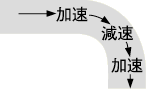
Question 46. The method of navigating a curve as shown in the figure is good.
Question 47. If you have a large motorcycle license and are over 20 years old, you can carry a passenger on a highway.
Question 48. To properly wear a seatbelt, keep the seatback upright and sit deeply in the seat.
Question 49. While riding a motorcycle, I had a puncture, so I pushed it on the sidewalk to a nearby repair shop with the engine still running.
Question 50. When riding a motorcycle on muddy or gravel roads, avoid using the brakes and maintain a steady speed with the throttle to keep balance.
Question 51. The owner of a vehicle must not use it unless the storage location is reported to the nearest driver's license testing center.
Question 52. I caught up with a tram stopped at a stop, but since there was a safety zone, I proceeded slowly.
Question 53. When changing course, making a U-turn, or reversing (except at roundabouts), you must first check safety using the rearview mirror and then signal.
Question 54. At night, on brightly lit roads with streetlights, you may drive without turning on the headlights.
Question 55. When parking an automatic car, put the gear lever in the R position.
Question 56. Car drivers must not drive vehicles that are poorly maintained or likely to pose a danger to traffic.
Question 57. Within 10 meters of a bus stop sign or pole during bus operating hours, parking is prohibited, but stopping is not.
Question 58. When turning a curve on a motorcycle, tilt the vehicle outward.
Question 59. Braking distance increases on wet roads but is not affected by the weight of the cargo.
Question 60. Illegal parking or stopping causes traffic congestion and obstructs the passage of emergency vehicles like fire trucks, so it must not be done.
Question 61. When towing a vehicle with a total weight of 2,000 kilograms or less using a vehicle with a total weight more than three times that, the maximum speed is 40 kilometers per hour.
Question 62. Snowy downhill roads are slippery, so use engine braking and lightly tap the foot brake intermittently.
Question 63. On national expressways, the maximum speed for large passenger vehicles and large cargo vehicles is the same.
Question 64. In areas not designated as no-parking zones, parking for 8 hours or more at night is allowed (except in designated areas of certain villages).
Question 65. A motorcycle has two brake systems—front and rear—so if one fails, you can still drive to a repair shop if the other is functioning.
Question 66. When the vehicle ahead is attempting to overtake a cargo vehicle, you must not start overtaking.
Question 67. Automatic cars have no differences in driving devices or methods compared to manual cars, so no special caution is needed when driving.
Question 68. The passenger capacity listed on the vehicle inspection certificate counts children under 12 years old as one person each.
Question 69. Even without a towing license, you can tow a broken-down vehicle with a rope or crane if you have a license for the towing vehicle.
Question 70. Even in no-parking zones, loading or unloading cargo is not considered parking regardless of the time taken.
Question 71. If a tire punctures while driving, first hold the steering wheel firmly, correct the vehicle's direction, and intermittently press the brake to stop.
Question 72. While driving on the highway, I felt sleepy and took a rest at a service area.
Question 73. This sign indicates that you must sound the horn.

Question 74. Ordinary vehicles must not enter a priority lane for route buses if traffic is congested and there is a risk of being unable to exit it.
Question 75. When making a U-turn or right turn (except at roundabouts), you must signal when reaching a point 30 meters before the intended action.
Question 76. When braking on a motorcycle, use the heel instead of the toes.
Question 77. I missed my exit on the highway, so I checked the rear for safety and reversed to the junction.
Question 78. On steep downhill slopes, acceleration can gain momentum and be dangerous, so you must not overtake other vehicles.
Question 79. This sign indicates that cars cannot pass, but motorized bicycles can.

Question 80. The user, driver, or person responsible for managing a vehicle with an abandoned vehicle confirmation tag can remove the tag.
Question 81. Flashing the right turn signal in a tunnel or on a foggy road to avoid being overlooked by oncoming vehicles can mislead other drivers and is dangerous.
Question 82. When overtaking the vehicle ahead, you must pass on its right side unless it is about to change course to the right.
Question 83. When dazzled by the headlights of an oncoming vehicle and momentarily unable to see ahead, it is best to shift your eyes to the left front.
Question 84. Near the top of an uphill slope, it is not always necessary to slow down.
Question 85. Since the headlight of a motorcycle is weak, keep it on high beam even when passing an oncoming vehicle.
Question 86. On roads of equal width (neither being a priority road) at an uncontrolled intersection (except roundabouts), you must yield to vehicles approaching from the left.
Question 87. At an intersection with this sign, a general motorized bicycle intending to turn right must first move toward the center of the road.

Question 88. When driving a passenger vehicle like a bus or taxi for passenger transport, you must have a Class 2 driver's license corresponding to that vehicle type.
Question 89. Since motorcycles with a displacement of 125cc or less are ordinary motorcycles, they can travel on highways.
Question 90. If the air pressure in the right front tire is lower than that in the left front tire, the steering wheel will pull to the left.
Question 91. You are driving at 30 km/h. What should you pay attention to while driving?
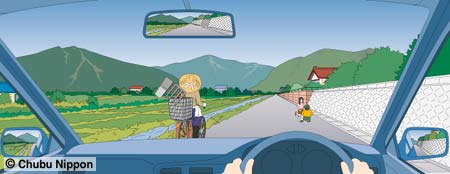
1. The bicycle and child may not notice my vehicle approaching, so I reduce speed to be ready to stop for sudden movements.
2. Passing the bicycle and child at the same time is dangerous, so I accelerate now to overtake the bicycle.
3. Continuing as is may not allow me to respond to sudden movements by the bicycle or child, so I reduce speed and follow the bicycle at a safe distance until passing the child.
Question 92. You are driving at 40 km/h. There is sand scattered on the road. What should you pay attention to while driving?
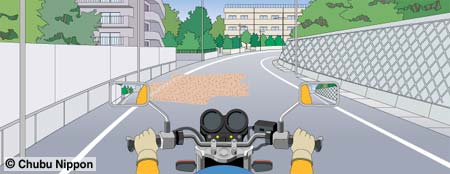
1. Motorcycles are highly maneuverable and can easily avoid oncoming vehicles, so I drive on the right side of the road to avoid the sand.
2. Sand is not particularly dangerous, so I enter the curve at the same speed.
3. Sudden maneuvers on sand may cause slipping, so I reduce speed and drive cautiously.
Question 93. You are driving at 30 km/h. What should you pay attention to while driving?
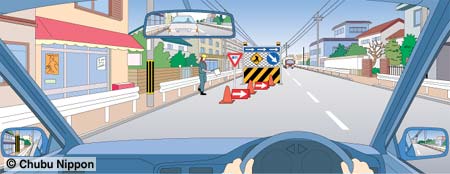
1. It’s unclear whether the oncoming vehicle will yield, so I reduce speed and observe.
2. The road narrows at the construction site, so I stop before it to let the oncoming vehicle pass first.
3. Suddenly slowing down to yield to an oncoming vehicle may cause a rear-end collision, so I brake intermittently to signal caution and stop.
Question 94. You are driving at 60 km/h. What should you pay attention to while driving?
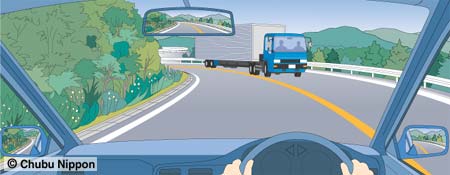
1. Continuing at this speed may cause me to veer into the oncoming lane, so I reduce speed immediately.
2. The trailer’s rear wheels may cross the centerline, so I reduce speed and drive as far to the left as possible.
3. The trailer likely notices my vehicle and will navigate the curve cautiously, so I continue at the same speed.
Question 95. You are driving at 30 km/h. What should you pay attention to when turning right at an intersection?
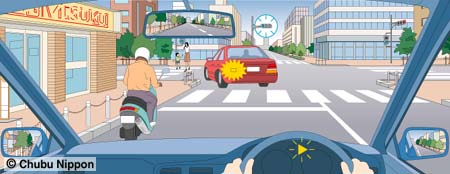
1. The four-wheeled vehicle ahead will likely turn left before the pedestrians on the crosswalk, so I continue as is.
2. The moped may veer to the right to avoid the four-wheeled vehicle turning left, so I reduce speed and watch its movements.
3. The moped will likely stop behind the four-wheeled vehicle when it stops, so I move to the right and turn right.