Honmen exam no 1
Question 1. An inspection sticker indicates the month and year in which the inspection was made.
Question 2. When tires wear down, the frictional resistance between the road surface and the tires decreases. Braking distance increases but reaction distance is not affected.
Question 3. An automobile may stop for ten minutes on a road where there is less than 3.5 meters of space between the right side of the vehicle and the right side of the road while the driver stands beside the vehicle and gives instructions for the loading of cargo.
Question 4. Cargo may not be loaded on the seats of a regular passenger vehicle.
Question 5. The traffic sign shown in Figure designates a bicycle crossing.

Question 6. On side strips as shown in Figure, light vehicles may proceed but other vehicles are not permitted to enter to park or stop.
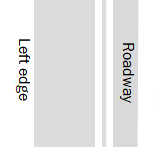
Question 7. Where there is a pavement marking as shown in Figure, vehicles are permitted to proceed but must not stop within it.

Question 8. On a downward slope, the increase in speed causes stopping distance to become longer, so drivers should allow more distance between vehicles than when on level ground.
Question 9. Because visibility is poor when it is raining, in order to avoid a head-on collision with an oncoming vehicle, it is best to approach the shoulder as close as possible and proceed.
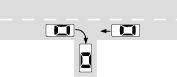
Question 10. When entering a roadside garage, it is best to enter as indicated by the arrows as shown in Figure.
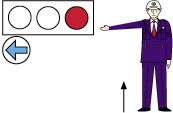
Question 11. For traffic proceeding in the direction of the thinner arrow as shown in Figure, the meaning of the police officer’s hand signal and that of the traffic signal are the same.
Question 12. When vehicles are proceeding in succession, if vehicles ahead are stopped at an intersection or railway crossing, or slowing down, vehicles must not take this opportunity to cut in on the clearance between vehicles or cross in front of them.
Question 13. When parking a regular motor vehicle on a general road in the daytime because of a breakdown, drivers should position an emergency warning reflector device or open the trunk or hood so that other drivers can see that the vehicle is broken down.
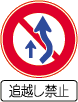
Question 14. Where there is a traffic sign as shown in Figure, vehicles must not change lanes or pass on the side in order to overtake automobiles or general mopeds.
Question 15. Because visibility is significantly worse at night than in the daytime, pedestrians, cyclists, and others become difficult to see and may be detected late, so drivers must drive at a speed lower than that at which they would drive on the same road in the daytime.
Question 16. When there are passengers getting on and off a streetcar, a driver must stop until all of the passengers or other people finish crossing the road, regardless of whether there is a safety zone or not.
Question 17. The necessary distance between vehicles on national expressways, assuming a dry road surface and new tires, is about 100 meters at 100 km/h.
Question 18. Corners are places where overtaking is prohibited and drivers must slow down.
Question 19. When the driver of a two-wheeled vehicle intends to proceed straight through an intersection, drivers of oncoming four-wheeled vehicles making right turns may make mistakes in judgment about distance or speed, so the driver of the two-wheeled vehicle must pay attention to the movement of the four-wheeled vehicles.
Question 20. When unavoidably forced to apply the brakes while driving at high speed, apply with several separate presses of the brake pedal, in addition to using the engine brake effectively.
Question 21. Drivers of two-wheeled vehicles may be slow to detect conditions ahead of the vehicle or dangers to the side because the movement of their viewpoint, which emphasizes the road surface, narrows their field of vision.
Question 22. On bad road surfaces such as mud or gravel, it is easy for the steering wheel to pull or the tires to slip, so the driver should reduce speed in advance and must not suddenly accelerate, brake, or swerve.
Question 23. On a road where there is a traffic sign as shown in Figure, large-size trucks, specified medium trucks, and special heavy equipment must travel in the leftmost lane.

Question 24. Where there is a traffic sign as shown in Figure, vehicles must not cross the road in order to enter or leave a location that is off the road on the left.

Question 25. When a vehicle collides with an object at rest, if it can decrease its speed to half, the kinetic energy at the time of impact will be just about one-quarter of that generated when speed is not decreased.
Question 26. Where there is a traffic sign as shown in Figure on the road, a driver must proceed as indicated by the red arrow.

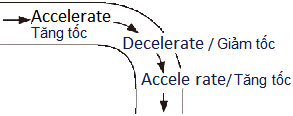
Question 27. The method of passing around the curve as shown in Figure is correct.
Question 28. The correct riding posture for two-wheeled vehicles is slouching forward so that wind pressure decreases, making driving easy.
Question 29. When the traffic signal is a flashing red light, vehicles must stop or slow down.
Question 30. When an automatic transmission vehicle is stopped and the gear shift is in a position other than "P" or "N", it will start to move even if the accelerator is not depressed due to the "creep" phenomenon, so the driver should engage the handbrake and firmly depress the brake pedal.
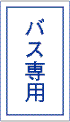
Question 31. Where there is a signboard as shown in Figure, only buses may follow the traffic signal indicated by the signboard.
Question 32. Getting a driver’s license means not simply that one can drive a vehicle. One must be aware that his or her social responsibilities, such as criminal, administrative, and civil obligations, become more serious.
Question 33. The owner of an automobile (excluding two-wheeled motor vehicles) must obtain a personal parking place for it that is not on a road and is within 5 kilometers of the address or other base position from which the automobile will be used.
Question 34. Vehicles other than large-size trucks loaded with cargo may not use the slower traffic lane of an expressway.
Question 35. If the driver notices that the vehicle behind is attempting to overtake the driver’s own vehicle, when intending to overtake the vehicle ahead and checking for safety, he or she should give up the attempt to overtake the vehicle ahead.
Question 36. The hand signal for slowing down is the same as that for stopping.
Question 37. Of the people who have only recently obtained a regular driver’s license, only people who are not confident in their driving display the novice driver sign; people who are confident in their driving are not required to display it.
Question 38. The seating capacity noted on the motor vehicle inspection certificate does not include the driver.
Question 39. When beginning to overtake a vehicle ahead, in order to finish within a short distance, a driver should move as close as possible to the vehicle and then change lanes.
Question 40. Traffic signs and pavement markings inform drivers of how to proceed, points requiring caution, and other details, in order to ensure that traffic flows safely and smoothly.
Question 41. The motor vehicle inspection certificate and a compulsory automobile liability insurance form (including a mutual relief system insurance certificate) are important documents, so in order to prevent loss or theft when driving one’s automobile, it is best to store them carefully in one’s home separately from the vehicle.
Question 42. Intersections and their vicinity are the most dangerous and accident-prone parts of the road, so in addition to paying attention to pedestrians and other vehicles, drivers must anticipate hidden dangers in places that can’t be seen and proceed at as safe a speed and manner as possible.
Question 43. If an emergency vehicle is at or near an intersection, vehicles must clear the intersection, move to the left side of the road, and come to a stop (except for on one-way streets).
Question 44. On roads where there is a traffic sign as shown in Figure, large-size and regular motorcycles may not proceed, but general mopeds may proceed.

Question 45. On a road where there is a traffic sign as shown in Figure, a passenger vehicle with 10 passengers may proceed.

Question 46. If unavoidably forced to park on an expressway due to a breakdown, the driver (and any passengers) should leave the vehicle and move to a safe location after completing the necessary measures to prevent danger.
Question 47. When proceeding through a railway crossing, even if one train has just passed by in one direction, there may be another train approaching from the opposite direction immediately afterward. Therefore, drivers must be sure to check the safety of the opposite direction.
Question 48. When driving down a long downward slope, drivers of four-wheeled vehicles should mainly apply the foot brake and drivers of two-wheeled vehicles should mainly apply the brakes on the front and back wheels. Engine braking should be used as an auxiliary.
Question 49. Caution is required when a two-wheeled vehicle passes a four-wheeled vehicle, because the two-wheeled vehicle may enter the blind spot of the four-wheeled vehicle and its driver may not be aware of the existence of the two-wheeled vehicle.
Question 50. When proceeding in a place such as a tunnel or in thick fog that inhibits one’s ability to see 50 meters ahead (200 meters on an expressway), the lights must be turned on, even in the daytime.
Question 51. If a pedestrian is crossing at or near an intersection that has no pedestrian crossing, a vehicle must reduce its speed, slow down, stop, or take other precautions so as not to hinder the pedestrian’s crossing.
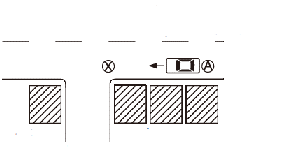
Question 52. In the situation shown in Figure, when vehicle A passes the point indicated by X, it must slow down.
Question 53. At night when the lights of an oncoming vehicle are too bright, it is best to stare at them so as to quickly get used to their brightness.
Question 54. When executing a right turn, the automobile must initially approach the right edge of the road as closely as possible and slow down immediately inside the center point of the intersection. (Except roundabout.)
Question 55. Some pedestrians such as elderly people and children behave in an unexpected manner, so drivers must carefully observe their movements.
Question 56. Parking and stopping are permitted in tunnels with vehicular lanes.
Question 57. Overtaking or passing a vehicle that is displaying a novice driver or senior driver sign is prohibited.
Question 58. Fatigue and its effects while driving are shown most strongly in the eyes; incidences of failing to notice something or mistaking what one sees become more frequent and one’s sense of judgment deteriorates.
Question 59. The use of a child seat is not required for a preschool child less than six years of age riding in the rear seat of a four-wheeled vehicle.
Question 60. Centrifugal force increases proportionally to the square of speed, and also increases as the radius of the curve decreases.
Question 61. Driving with a suspended license during the suspension period constitutes driving without a valid license.
Question 62. When the road is congested, automobiles and general mopeds may enter the side strip and proceed.
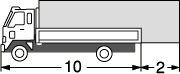
Question 63. If loading cargo that cannot be divided as shown in Figure, a driver need not obtain a permit from the police chief having jurisdiction over the place of departure.
Question 64. When a vehicle attempts to overtake the vehicle ahead, the vehicle ahead may not notice and begin to change to the right lane. If the driver of the overtaking vehicle senses danger, he or she may sound the horn.
Question 65. At intersections between roads with three or more lanes in each direction (multi-lane roads) and with traffic control, if there is no indication from traffic signs, etc., general mopeds must execute a right turn using the two-step method.
Question 66. The owner of a vehicle must never lend it to a person who does not have a driver’s license or to a person who has been drinking alcohol, or allow it to be taken without permission by others.
Question 67. The traffic sign in Figure indicates that there is a danger of animals appearing suddenly on the road.

Question 68. When overtaking another vehicle on a road where the width of the left half of the road is less than 6 meters and where visibility is good, vehicles may cross the centerline into the part of the road on the right (except where prohibited by traffic signs or pavement markings).
Question 69. Parking is prohibited within 5 meters of a fire hydrant, a place where firefighting equipment is stored, or a fire alarm.
Question 70. One must not offer or recommend alcohol to someone who may drive later.
Question 71. When vehicle A and vehicle B are approaching an intersection that has no traffic signal and the streets are the same width, as shown in Figure, vehicle A may not obstruct the progress of vehicle B.
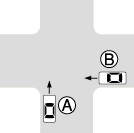
Question 72. In the situation shown in Figure, vehicle A has entered the intersection first intending to execute a right turn. If vehicle B proceeds straight through, vehicle A must wait inside the intersection until it passes, but if vehicle B is executing a left turn, vehicle A may go ahead and execute a right turn.
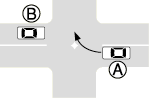
Question 73. The hydroplaning phenomenon, which occurs while driving at high speed, is the “standing wave” phenomenon that occurs when tire pressure is low.
Question 74. When the brake is applied in response to danger, there is about 1 second of reaction time until the brake begins to take effect, so drivers must take this into consideration when driving.
Question 75. While driving on a national expressway and the driver feels tired, he or she may enter a sufficiently wide side strip to rest.
Question 76. If a little coolant or oil is leaking under the vehicle, that is not a mechanical breakdown, so the vehicle may be driven.
Question 77. If a driver is unavoidably forced to park on an expressway because the vehicle cannot be driven due to a breakdown, etc., the driver must park on a sufficiently wide shoulder or side strip.
Question 78. If the pressure of the front right tire is lower than that of the front left tire, the steering wheel will pull to the left.
Question 79. When a driver is being overtaken by another vehicle, it is not particularly necessary for the driver to give way in their lane, as long as he or she does not accelerate, and even if there is not enough room between his or her vehicle and the vehicle in front.
Question 80. When parking or stopping a regular motor vehicle on a general road at night, even if the driver positions an emergency warning reflector device at the rear of the vehicle, he or she must turn on the hazard lights, parking lights, or tail lamps.
Question 81. If drivers feel even slightly sleepy while driving at night, they should stop the vehicle in a safe location and take a nap or rest for a short time, resuming driving after they feel refreshed.
Question 82. Where there is a traffic sign as shown in Figure, vehicles loaded with cargo of a height of up to 3.3 meters from the cargo bed may proceed.

Question 83. When the hand brake of a four-wheeled vehicle is pulled all the way, there should not be any room to pull it further.
Question 84. At intersections with a traffic signal but no stop line, the correct position to stop is immediately before the traffic signal.
Question 85. The traffic sign shown in Figure designates a national expressway or a motorway.

Question 86. If a two-wheeled vehicle is being driven in a position that can be seen from a four-wheeled vehicle, it won’t be overlooked by the driver of the four-wheeled vehicle.
Question 87. The hand signal to use when reversing is as follows: signal with the arm extended diagonally downward from the vehicle and the palm facing back, waving backward.
Question 88. If driving for a long period, a driver should stop driving once every two hours and have a rest.
Question 89. The traffic sign shown in Figure warns drivers that the shoulder crumbles easily.

Question 90. Even when it looks as though there will be a head-on collision with an oncoming vehicle, the driver should not give up but should try to avoid the vehicle, even if just a little, by using the brake or steering wheel.
Question 91. You are driving along at 25 km/h. What kinds of things should you be careful of?
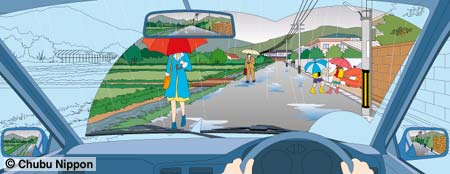
1. The pedestrians might not have noticed my vehicle approaching, so I’ll reduce my speed and observe their movements.
2. I’ll reduce my speed so that I won’t splash the pedestrians with water or mud when I pass them.
3. The children on the right are playing and might dash out in front of my vehicle, so I’ll drive at a speed at which I can stop at any time.
Question 92. You are driving along at 35 km/h. Because of construction, the road is covered with steel plates. What kinds of things should you be careful of?
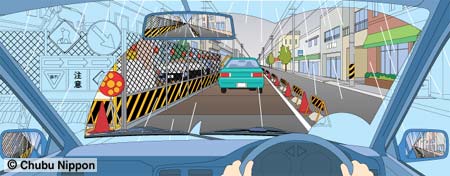
1. Construction workers might come out suddenly from the construction site on the left, so I’ll reduce my speed and watch out as I drive.
2. The surface of the wet steel plates is extremely slippery, so I’ll reduce my speed in advance and maintain the distance between my vehicle and the vehicle ahead so that I won’t have to brake suddenly.
3. Rain impedes visibility, making it difficult to see the conditions ahead, so I’ll drive up close to the vehicle in front of me.
Question 93. You are driving along at 40 km/h. What kinds of things should you be careful of?
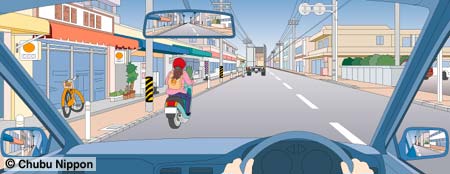
1. I think the moped will notice my vehicle approaching and stop in front of the parked vehicle to yield the road, so I’ll keep driving just as I am now.
2. The moped might move in front of my vehicle, so I’ll follow it until we pass beside the parked vehicle.
3. There don’t seem to be any oncoming vehicles, so I’ll accelerate and overtake the moped and the parked vehicle in one move.
Question 94. You are driving along at 40 km/h. What kinds of things should you be careful of?
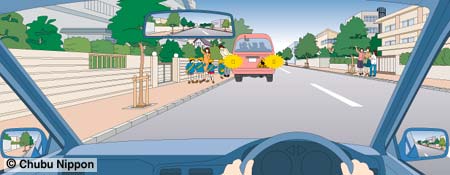
1. I don’t think the kindergarten bus will start moving yet, so I’ll cross over into the lane of oncoming traffic and keep driving just as I am now.
2. I don’t think any of the children will dash out into the street because there is an adult with them, so I’ll keep driving at this speed.
3. There might be children crossing in front of the kindergarten bus, so I’ll sound my horn and keep driving.
Question 95. While you are driving on an expressway at 80 km/h, the hazard lights of the vehicle ahead begin to flash. What kinds of things should you be careful of?
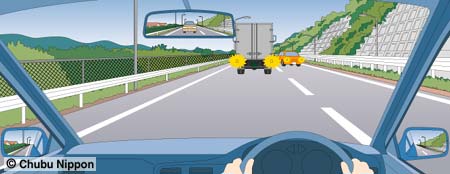
1. The vehicle ahead might suddenly reduce its speed and I’ll hit it, so I’ll apply the brakes suddenly.
2. I think the vehicle ahead is having a malfunction and will pull over to the left to stop, so I’ll quickly change lanes into the overtaking lane.
3. If I apply the brakes suddenly I might be hit by the vehicle behind me, so to warn the driver I’ll turn on my hazard lights and apply the brake with several separate presses of the brake pedal.