Motorcycle exam no 9
30:00
Question 1. An ordinary motorcycle license is required to ride a new-standard moped (125cc or less with a maximum output of 4.0 kW or less).
Question 2. A new-standard moped must also make a two-step right turn at intersections where the two-step method is required.
Question 3. A specified small motorized bicycle may be ridden by anyone aged 14 or over.
Question 4. A specified small motorized bicycle must also be covered by compulsory automobile liability insurance or liability mutual aid.
Question 5. On an ordinary road with a center line and no posted speed limit, a moped may also go up to 60 km/h.
Question 6. On residential roads without a center line, the maximum speed for motor vehicles is 30 km/h unless otherwise posted.
Question 7. A person with a small special vehicle license can ride a moped.
Question 8. Even if a police officer asks you to show your license after a violation, you are not obliged to comply.
Question 9. At night you must always ride with your headlight on low beam, whether or not there are oncoming vehicles.
Question 10. At night, when riding directly behind another vehicle, you must dim your headlight or switch it to low beam.
Question 11. If you feel sleepy while driving, you may keep driving as long as you open a window to let in fresh air.
Question 12. Even when you are exhausted from overwork, it is fine to drive as long as you are more careful than usual.
Question 13. As a rule, you must pass on the left side when overtaking another vehicle.
Question 14. When the vehicle ahead has moved toward the center of the road to turn right, overtake it on its left side.
Question 15. After overtaking, it is best to cut in right in front of the overtaken vehicle and return to the left as soon as possible.
Question 16. Even if changing course would force the vehicle behind to brake hard, you may change course as long as you signal.
Question 17. When you are traveling on a priority road, an intersection with poor visibility to the left and right is not a place where you are required to slow down.
Question 18. When traveling on a priority road, overtaking is not prohibited even in an intersection or within 30 meters before it.
Question 19. At an uncontrolled intersection, when entering a wide road from a narrow one, you may go before vehicles on the wide road if you are coming from their left.
Question 20. At a crosswalk or bicycle crossing and within 30 meters before it, you must not only not overtake but also not pass other vehicles.
Question 21. People who happen to be at the scene of a traffic accident are not involved, so they need not help the injured.
Question 22. If you learn while driving that an earthquake warning declaration has been issued, prepare for an earthquake: stay calm, drive at low speed, and listen to earthquake and traffic information on the radio.
Question 23. When continuing to drive after a major earthquake, there is no need for special care because traffic signals work as usual.
Question 24. Vehicle exhaust contains substances harmful to the human body, such as carbon monoxide, hydrocarbons and nitrogen oxides.
Question 25. A moped may use a road with this sign.

Question 26. A moped may enter a road with this sign.

Question 27. On a road with this sign, vehicles more than 3.3 meters high, including their load, may not pass.

Question 28. Within the section where this sign is posted, you must keep sounding your horn at all times.

Question 29. At an intersection with this sign, you must always come to a full stop.

Question 30. On a road with this sign, mopeds may also ride two abreast.

Question 31. This sign indicates the center of the road or the center line.

Question 32. This sign indicates that the road ahead is one-way.

Question 33. When inspecting a two-wheeler, check that the handlebars are not heavy, the cables do not catch, and there is no play.
Question 34. When riding in fog, you must not use the horn so as not to startle other vehicles or pedestrians.
Question 35. On mountain roads, the closer you keep to the shoulder when passing oncoming vehicles, the safer it is.
Question 36. Steel plates at construction sites and streetcar rails are not slippery even on rainy days.
Question 37. Mopeds may also park in places with a parking sign reserved for elderly drivers and others.
Question 38. If a police officer orders you to move an illegally parked vehicle, you may leave it there until you have finished your business.
Question 39. When there is a safety zone next to a streetcar stopped at a stop, you may proceed slowly.
Question 40. Even when people are getting on or off a streetcar stopped at a stop, you may proceed slowly if there is at least 1.5 meters between you and the streetcar.
Question 41. Even in no-parking places, such as where a no-parking sign is posted or within 1 meter of a fire alarm, you may park if you have permission from the chief of the police station.
Question 42. Within 5 meters of a bend in the road, parking is prohibited but stopping is allowed.
Question 43. You must neither park nor stop inside a tunnel.
Question 44. This sign indicates that the road surface ahead is uneven.

Question 45. Where there is no stop line, the stop position means just before the intersection, or just before the crosswalk if there is one right next to the intersection.
Question 46. You must not cross the road or make a U-turn when doing so may obstruct pedestrians or the normal flow of other vehicles.
Question 47. As long as you are wearing a riding helmet, it does not matter if the chin strap is not fastened.
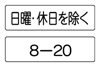
Question 48. This auxiliary sign indicates that the regulation of the main sign applies from 8:00 to 20:00 except on Sundays and holidays.