Motorcycle exam no 4
30:00
Question 1. When following a vehicle through a railway crossing, there is no need to stop temporarily if safety is confirmed.
Question 2. When a police officer’s or traffic patrol’s hand signals differ from the traffic signal, the police officer’s hand signals take priority, but for a traffic patrol, the traffic signal takes priority.
Question 3. A moped overtook a slow-moving small special vehicle near a visible road curve.
Question 4. The road ahead was congested, and there was a risk of stopping on a pedestrian crossing, but since no pedestrians were passing, I proceeded.
Question 5. When stopping on an uphill slope, it is good to stop without getting too close to the vehicle in front.
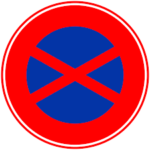
Question 6. At a place with this sign, parking is prohibited, but stopping is not.
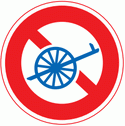
Question 7. Mopeds cannot travel at a place with this sign.
Question 8. When there is a vehicle stopped before a pedestrian crossing, you are obligated to pass it slowly.
Question 9. While traveling in a roundabout, you must yield to vehicles entering from the left.
Question 10. Even if you knowingly ask a drunk driver to deliver goods on a moped, there is no penalty for the requester.
Question 11. If a moped is equipped with a passenger device, it is possible to drive with a child or other passenger.
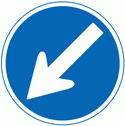
Question 12. At an intersection with this sign, traveling on the right side of the sign is prohibited.
Question 13. Even if you cause a traffic accident, there is no obligation to report to the police if the other party has minor injuries.
Question 14. The lower the road’s friction coefficient, the stronger the brakes work.
Question 15. A moped can carry cargo up to 30 kg.
Question 16. When passing near a pedestrian, you must always maintain a safe distance and proceed slowly.
Question 17. Even in a no-overtaking zone, a moped can overtake.
Question 18. Using engine braking in places other than downhill slopes does not affect braking distance.
Question 19. In a tunnel with vehicle lanes, it is possible to overtake cars or mopeds.
Question 20. The horn must not be used unnecessarily, except to avoid danger or at places with a 'Sound Horn' sign.
Question 21. At a place with this sign, stopping is possible even if parking and stopping are prohibited.
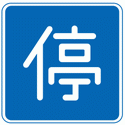
Question 22. On a road without vehicle lanes, you can travel anywhere on the left side of the centerline.
Question 23. When riding a moped on muddy or gravel roads, it is good to use a high gear and accelerate to pass.
Question 24. Even if a driver applies sudden brakes upon recognizing danger, it takes time for the brakes to engage, so the faster the speed, the more dangerous.
Question 25. You must always drive in accordance with the conditions listed on your driver’s license.
Question 26. When a moped attempts to overtake a regular car, it must pass on the left side.
Question 27. An illegally parked vehicle that the driver has left and cannot drive immediately is called an 'abandoned vehicle.'
Question 28. At night, if the headlights of an oncoming vehicle are dazzling, it is good to shift your gaze slightly to the left front to avoid being blinded.
Question 29. If there are pedestrians in a safety zone, it is possible to proceed slowly.
Question 30. A flashing yellow light requires you to stop temporarily at the stop position, confirm safety, and then proceed.
Question 31. When traveling on the road, in addition to following traffic rules, you must pay close attention to road and traffic conditions.
Question 32. Centrifugal force increases as the radius of a curve decreases.
Question 33. When making a sharp right turn from a one-way road on a moped, you must keep to the left edge of the road and proceed slowly through the inner side of the intersection.
Question 34. Except in unavoidable cases, you must not drive in a way that requires sudden braking.
Question 35. Proceeding slowly means driving at a speed that allows the vehicle to stop immediately.
Question 36. At a railway crossing, start in a low gear, quickly shift up, fully turn the throttle grip, and pass through rapidly.
Question 37. When braking on a dry road with a two-wheeled vehicle, it is good to apply the front brake slightly harder.
Question 38. When starting, signal with the turn indicator and check the safety of the surroundings using the rearview mirror.
Question 39. In case of an emergency, it is good to have car insurance and acquire knowledge of first aid procedures.
Question 40. When being overtaken by another vehicle, keep as far to the left as possible and do not increase speed until the overtaking is complete.
Question 41. The height limit for cargo on a moped’s cargo bed is up to 3 meters from the ground.
Question 42. A moped can be driven if it has optional insurance, even without compulsory liability insurance.
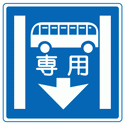
Question 43. Mopeds can travel in the lane with this sign.