Motorcycle exam no 3
30:00
Question 1. While driving, an emergency vehicle approached from behind, but since it was not near an intersection, I continued driving slowly.
Question 2. In case of traffic congestion causing long delays, it is possible to stop on a bicycle crossing.
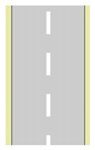
Question 3. The centerline of this marking prohibits overtaking by crossing to the right side.
Question 4. In case of potential photochemical smog due to air pollution, you should refrain from driving.
Question 5. After bus operating hours, I stopped within 10 meters of a bus stop to go shopping.
Question 6. At night, even when parking or stopping with a warning device, the tail light must be turned on.
Question 7. In case of a personal injury accident, immediately stop to prevent further accidents, avoid obstructing traffic, protect the injured, and then report to the police.
Question 8. When making a right turn on a one-way road, you must approach the center of the road and proceed slowly around the inner side of the intersection.
Question 9. When towing a disabled vehicle with a rope, both the towing vehicle and the disabled vehicle’s driver must have a valid license to drive that vehicle.
Question 10. When traffic is light, you can change lanes even if the vehicle lane is marked with a yellow line.
Question 11. With a moped license, you can only drive a moped.
Question 12. A moped can travel in the roadside strip if no pedestrians are passing.
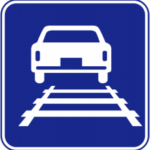
Question 13. On tram tracks with this sign, mopeds can also travel within the tram track area.
Question 14. If the road ahead is congested and continuing would risk stopping in a railway crossing, you must not enter the crossing.
Question 15. If a vehicle is marked with an abandoned vehicle confirmation tag for a parking violation, the driver must not remove the tag even when driving the vehicle.
Question 16. Passing through deep puddles can cause water to enter the brake drum, making the brakes ineffective.
Question 17. Exceeding speed or load limits does not affect driving noise or exhaust sound.
Question 18. Even if the driver applies sudden brakes upon sensing danger, the vehicle does not stop immediately.
Question 19. Overtaking is prohibited in tunnels only when there are vehicle lanes.
Question 20. While traveling on a one-way road away from an intersection, I yielded to an emergency vehicle approaching from behind by moving to the left.
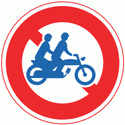
Question 21. On a road with this sign, mopeds can carry two people.
Question 22. Even if the left side of the road is 6 meters or wider, you can overtake by crossing to the right side unless it is a no-overtaking zone.
Question 23. Worn tire treads make slipping more likely on rainy days and increase stopping distance.
Question 24. At an intersection with this sign, turning left onto a diagonal road is prohibited.
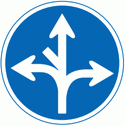
Question 25. If the traffic signal changes from green to yellow before an intersection, it is better to accelerate and pass through quickly.
Question 26. On a road with this sign, since the number of lanes decreases, you must travel in the right lane.
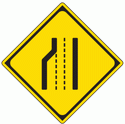
Question 27. At night, since it is hard to see far ahead while driving, you should keep your gaze as close to the vehicle as possible.
Question 28. When crossing a sidewalk with a moped, if there are no pedestrians, it is possible to proceed slowly.
Question 29. When braking on a dry road with a two-wheeled vehicle, it is better to apply the rear brake slightly harder.
Question 30. Passing a vehicle stopped to let passengers off and stopping in front of it does not constitute cutting in.
Question 31. When loading or unloading within 5 meters of firefighting equipment, you can stop for more than 5 minutes if the driver is ready to drive immediately.
Question 32. Engine braking becomes more effective as you shift to lower gears.
Question 33. Since the traffic signal ahead turned red, I stopped at the area with this marking.

Question 34. Applying the brake multiple times causes the brake light to flash, helping prevent rear-end collisions.
Question 35. At a place with this sign, you can pass with a two-wheeled vehicle by turning off the engine, dismounting, and pushing it.
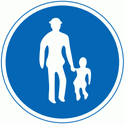
Question 36. A person whose moped license is suspended must not drive a moped during that period.
Question 37. At night, since there are fewer pedestrians and less traffic, it is safe to drive faster than during the day.
Question 38. For automatic two-wheeled vehicles with a continuously variable transmission, engine power is more easily transmitted to the wheels at low RPMs.
Question 39. During a two-wheeled vehicle inspection, a brake lever play of about 20–30 mm is appropriate.
Question 40. Even if the traffic signal is red, if a green left arrow is displayed, all vehicles can turn left.
Question 41. Even if the side traffic signal is red, the signal ahead is not necessarily green.
Question 42. Since two-wheeled vehicles may not be visible to four-wheeled vehicles, their drivers need to pay extra attention to surrounding traffic.
Question 43. A vehicle with a damaged muffler that produces loud exhaust noise must not be driven.
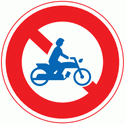
Question 44. Mopeds cannot travel on a road with this sign.