Motorcycle exam no 2
30:00
Question 1. When there is a stop sign, you must stop just before the stop line, check for safety, and then proceed.
Question 2. At a tram stop without a safety zone, if there are no passengers boarding or alighting, you can proceed slowly while maintaining a 1.5-meter gap from the tram.
Question 3. Although the traffic signal was green, I stopped just before the stop line because a police officer in the center of the intersection raised both arms horizontally.
Question 4. Mopeds may travel on bicycle paths when traffic is light.
Question 5. When signaling a right or left turn on a moped, only the turn indicator should be used, and hand signals must not be used.
Question 6. It is fine to stop near the top of an uphill slope to unload cargo.
Question 7. The correct way to brake on a two-wheeled vehicle is to use engine braking while applying both front and rear brakes simultaneously.
Question 8. If you enter an intersection on a green signal to make a right turn and the signal changes to yellow or red while stopped, you must remain stopped.
Question 9. When catching up to a bus stopped at a bus stop, you must stop behind it until the bus starts moving.
Question 10. On a road with tram tracks in the center, you must pass a tram on its left side when overtaking.
Question 11. When attempting to cross a railway crossing, the barrier began to lower, but since the train was not yet visible, I hurried through.
Question 12. On a one-way road, it is possible to travel beyond the center of the road to the right side.
Question 13. Sudden acceleration or braking is not only dangerous but also a source of traffic pollution.
Question 14. In a disaster, if you must park on the road to evacuate, you must not park in a place that obstructs evacuees or earthquake disaster response measures.
Question 15. When navigating a curve on a moped, it is best to lean the vehicle to naturally turn.
Question 16. A moped must proceed slowly if the distance from a pedestrian is not safe.
Question 17. If you signal to start the vehicle, there is no need to check the safety of the surroundings.
Question 18. In the event of a traffic accident, it is better to take measures such as stopping bleeding while waiting for an ambulance.
Question 19. On a road without vehicle lanes, you may travel anywhere on the left side of the centerline.
Question 20. On long downhill slopes, it is better to use engine braking rather than excessively using the brakes.
Question 21. When a person with a physical disability is trying to pass in a wheelchair, you must stop temporarily or proceed slowly to avoid obstructing them.
Question 22. The width limit for cargo on a moped is the width of the cargo device plus 10 cm on each side.
Question 23. Even if a moped is equipped with a passenger seat, two-person riding is not allowed.
Question 24. You must not overtake a vehicle that is changing its course to the right to make a right turn.
Question 25. At night on roads with many oncoming vehicles, it is safer to drive with high beams to alert others.
Question 26. Brakes work better when carrying heavy cargo than when not carrying cargo.
Question 27. Even if you follow traffic rules, selfish and reckless driving not only inconveniences others but also endangers yourself.
Question 28. For automatic two-wheeled vehicles with a continuously variable transmission, engine power is less effectively transmitted to the wheels at low RPMs.
Question 29. Mopeds cannot travel in the lane with this sign.
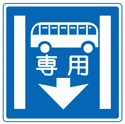
Question 30. You must proceed slowly when passing near a road curve.
Question 31. At an intersection with a flashing yellow light, you must always stop temporarily and check for safety before proceeding.
Question 32. To prevent the head from getting stuffy, a lightweight construction helmet is sufficient.
Question 33. You cannot park or stop within 5 meters before or after a pedestrian crossing.
Question 34. When a child is walking alone, you must stop temporarily or proceed slowly to ensure their safe passage.
Question 35. The first year after obtaining a moped license is called the novice driver period, and those who commit violations reaching a certain threshold during this period must attend a novice driver course.
Question 36. You cannot park parallel to the right side of a parked vehicle, but stopping is allowed.
Question 37. On a road with this sign, only trucks carrying cargo can use the climbing lane.
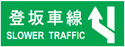
Question 38. On a road with this sign, since the number of lanes decreases, you must travel in the right lane.
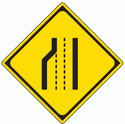
Question 39. You must signal 30 meters before making a right or left turn or U-turn, but for slowing down or stopping, signaling at the time is sufficient.
Question 40. Using a mobile phone while driving is dangerous, so if you must use it, stop the vehicle in a safe place first.
Question 41. On rainy days, the road is slippery and stopping distance is longer, so it is better to keep a greater distance between vehicles than on clear days.
Question 42. The legal maximum speed for a moped, unless otherwise specified by signs or markings, is 40 km/h.
Question 43. If there is an obstacle ahead, you must stop temporarily or slow down and yield to oncoming vehicles.
Question 44. When exiting a dark tunnel into a bright area, your vision may temporarily decrease significantly, making it hard to see.
Question 45. Regular cars cannot travel on a road with this sign, but mopeds can.
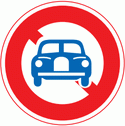
Question 46. A vehicle turning right must not obstruct straight-going vehicles, left-turning vehicles, or trams, even if it enters the intersection first (except at roundabouts).
Question 47. This marking indicates the end of a no-U-turn zone, so a U-turn is possible.

Question 48. On a road with this sign, you must drive carefully, watching for merging vehicles from the left.
