Motorcycle exam no 10
30:00
Question 1. You must be at least 16 years old to obtain a moped license.
Question 2. A person with a large special vehicle license can ride a moped.
Question 3. As long as you obey the traffic rules, you do not need to think about bothering people living along the road with noise and the like.
Question 4. Two-wheeler riders also need to know the characteristics of cars, such as their blind spots and inner wheel difference.
Question 5. Know that a remotely operated small vehicle may have no operator nearby and may stop suddenly on the road.
Question 6. When choosing a two-wheeler, check whether you can easily put it on its center stand on level ground.
Question 7. In traffic jams, be careful because people in the car ahead may suddenly open a door, or pedestrians may dart out from between cars.
Question 8. When turning left at an intersection, it is best to move toward the center of the road beforehand and make a wide turn.
Question 9. When the left side of the road is not wide enough to pass because of construction or the like, you may go over into the right side of the road.
Question 10. On a road with lanes, it is better to pick whichever lane is empty and change lanes frequently.
Question 11. When a vehicle running alongside you is slow, you may pull close to it to make it give way.
Question 12. The hand signal for slowing down or stopping is to extend your arm outward and diagonally downward.
Question 13. Putting your right arm out of the right side and bending the elbow straight up is the hand signal for a left turn or moving to the left.
Question 14. At an intersection with a 'stop' sign, once you have stopped, you may go before vehicles on the crossing road.
Question 15. When counting the lanes that make a two-step right turn necessary for mopeds, lanes for turning right or left near the intersection are included.
Question 16. Even at a signalized intersection on a road with three or more lanes, a moped turns right by the small-turn method unless there is a 'two-step right turn for mopeds' sign.
Question 17. Outside intersections, where there is a crosswalk or railroad crossing with a signal, the stop position is just before the crosswalk or crossing.
Question 18. When passing an oncoming vehicle, keep a safe distance from it.
Question 19. At night, when following another vehicle, pay attention to its brake lights.
Question 20. On snowy roads, sudden starts and sharp steering are not dangerous as long as you are used to it.
Question 21. Modified handlebars interfere with riding, so such a modification must not be made.
Question 22. When inspecting a two-wheeler, checking the brakes and tires is enough, and there is no need to check the lights or mirrors.
Question 23. This sign indicates that there is a traffic signal ahead.

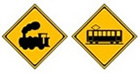
Question 24. This sign indicates that there is a streetcar stop ahead.
Question 25. This sign indicates a pedestrian crosswalk.

Question 26. This sign indicates a road for bicycles only.

Question 27. A moped may use a road with this sign.

Question 28. On a road with this sign, vehicles whose total weight, including people and cargo, exceeds 5.5 tons may not pass.

Question 29. A road with this sign is for pedestrians only, and no vehicles may use it except those specially permitted.

Question 30. At an intersection with this sign, you must stop just before the stop line (or just before the intersection if there is no stop line).

Question 31. Pedestrians may use a road with this sign.

Question 32. Where this sign is posted, vehicles may neither make a U-turn nor cross the road.

Question 33. Even on a road with this sign, you may cross the road with a left turn to enter or leave a facility or place off the road.

Question 34. Where this sign is posted, you must come to a full stop.

Question 35. When passing a place with this sign, you must sound your horn.

Question 36. This sign indicates a steep downhill slope ahead.

Question 37. If no one is injured in a traffic accident, there is no need to report it to the police.
Question 38. When riding a two-wheeler, it is best to keep your eyes on the road surface just in front of the vehicle.
Question 39. When inspecting a two-wheeler, check that the wheels have no play or distortion.
Question 40. Since an automatic two-wheeler needs no clutch operation, it may be handled more casually than a manual one.
Question 41. Stopping distance is the free running distance plus the braking distance.
Question 42. When a four-wheeled vehicle turns right or left, its rear wheels pass outside the path of the front wheels.
Question 43. Even in a no-stopping place, you may stop for loading or unloading that takes 5 minutes or less.
Question 44. When you stop and leave your vehicle, to prevent theft, stop the engine, take the key with you, and use any anti-theft device such as the handlebar lock.
Question 45. To reduce traffic pollution, it is better to keep the engine running while parked or stopped.
Question 46. This sign indicates that the road ahead is under construction.

Question 47. When riding a two-wheeler through mud or gravel, it is good to keep your balance with hard braking and large steering movements.
Question 48. This sign indicates that animals may run out onto the road.

Question 49. This sign indicates that you need to watch out for crosswinds.
